

In the landscape of Australian wealth creation, understanding Capital Gains Tax (CGT) is a cornerstone of prudent financial stewardship. It is the tax you pay on the profit from selling an asset, such as property or shares, and it can significantly impact the net returns on your investments.
While CGT is a fundamental part of our tax system, the Australian Taxation Office (ATO) also provides a clear framework of legitimate capital gains tax strategies Australia has available to manage its impact. This is not about finding obscure loopholes; it is about making informed, disciplined decisions that align with your long-term financial goals and are grounded in current Australian tax law. With a calm and steady hand, you can navigate the complexities of CGT, preserving the capital you have worked diligently to build.
This guide is designed to break down these complex matters into clear, simple steps. We will explore a comprehensive roundup of actionable strategies, from the main residence exemption and the 50% CGT discount to the strategic use of trusts and small business concessions. Whether you are a professional managing a share portfolio, a business owner planning for succession, or a family building for its future, these strategies offer a clear roadmap. The insights provided highlight both opportunities and responsibilities, helping you make wise decisions based on a clear understanding of the rules. Careful planning and patient, disciplined action are the hallmarks of enduring financial success.
1. Capital Gains Tax Discount (50% Discount for Individuals)
The Capital Gains Tax (CGT) discount is one of the most significant and widely used capital gains tax strategies in Australia. This provision allows individuals and some other entities to reduce their assessable capital gain by 50%, provided they have held the asset for at least 12 months before selling it. This means only half of your net capital gain is added to your taxable income for the year. It is a cornerstone of long-term investment planning in Australia, grounded in ATO guidelines.

This strategy is designed to encourage patient, long-term investment over short-term speculation. It applies to a broad range of assets, including shares and investment properties. The 12-month holding period is calculated from the date you enter into the contract to acquire the asset to the date you enter into the contract to dispose of it.
Practical Examples
Let's consider two common scenarios relevant to Australian investors:
- Shares: A medical professional purchases a parcel of ASX-listed shares for $100,000 in January 2023. They sell the entire holding in February 2024 for $150,000, realising a capital gain of $50,000. Because the shares were held for more than 12 months, the investor may apply the 50% CGT discount. The assessable capital gain could be reduced to just $25,000 ($50,000 x 50%).
- Investment Property: A local family buys an investment property for $500,000 and sells it three years later for $700,000. The gross capital gain is $200,000. After applying the 50% discount, the assessable capital gain becomes $100,000. This is the amount added to their income for tax purposes. This strategy is also relevant in estate planning, as beneficiaries may need to understand how CGT applies when they inherit and later sell an asset. You can explore how this may affect inherited assets and find more information on how you might reduce tax on inheritance capital gains.
Actionable Tips for Implementation
To effectively use the 50% CGT discount, depending on your circumstances, you could consider the following steps:
- Maintain Meticulous Records: Keep clear and accurate records of purchase and sale dates (contract dates, not settlement dates), along with all associated costs. This is an essential compliance obligation for proving your eligibility for the discount.
- Strategic Timing: If the 12-month holding period is approaching, it may be beneficial to delay the sale. Holding an asset for a few extra weeks could halve your tax liability on the gain.
- Marginal Rate Awareness: The final tax paid depends on your marginal tax rate in the year of the sale. If you anticipate a lower income in a future financial year (e.g., due to retirement), deferring the sale could result in further tax savings. Always seek personal advice on such decisions.
- Combine with Other Strategies: The 50% discount is particularly effective when used in conjunction with other strategies like tax-loss harvesting, where capital losses are used to offset gains before the discount is applied.
2. Capital Losses Harvesting and Carry-Forward
Tax-loss harvesting is a fundamental capital gains tax strategy in Australia. It involves strategically selling assets that are currently valued at a loss to offset capital gains realised from other investments. Australian tax law allows you to subtract your total capital losses from your total capital gains in a financial year. If you have a net capital loss, it can be carried forward indefinitely to offset capital gains in future years, though it cannot be used to reduce other types of income like your salary.

This technique allows investors and business owners to manage their overall CGT liability on an ongoing basis. Rather than viewing investment losses solely as a negative outcome, they can be repurposed as a tool to minimise tax on successful ventures. It is a method of turning an underperforming asset into a tax-optimisation opportunity, smoothing out the tax impact of portfolio gains over time.
Practical Examples
Let's explore how this strategy works in different situations:
- Share Portfolio Balancing: An investor realises an $80,000 capital gain from selling a successful parcel of shares. In the same financial year, they sell another holding that has underperformed, realising a capital loss of $50,000. They can offset the gain with the loss, resulting in a net capital gain of only $30,000. This is the amount that is then considered for the 50% CGT discount if applicable.
- Carrying Forward Losses: A portfolio manager experiences a significant market downturn in the 2024 financial year, realising $200,000 in capital losses and only $50,000 in gains. This results in a net capital loss of $150,000. This loss cannot be used to offset their salary income. Instead, it is carried forward. In the 2025 and 2026 financial years, they could use this carried-forward loss to offset future gains.
- Underperforming Property: A new migrant sells an underperforming investment property, incurring a capital loss of $50,000 after all costs are accounted for. In the same year, they sell a collection of valuable art, realising a capital gain of $70,000. The property loss reduces the assessable gain from the art to $20,000.
Actionable Tips for Implementation
To effectively use capital loss harvesting, consider the following steps:
- Systematic Loss Tracking: Maintain a detailed and ongoing record of all realised capital losses. This is crucial for accurately calculating your net position and ensuring you claim them correctly in future years.
- Annual Portfolio Review: Before the end of each financial year, you could review your investment portfolio to identify any assets with unrealised losses. This allows for strategic decisions about whether to sell and "harvest" those losses to offset gains already made.
- Be Aware of Wash Sales: The ATO has anti-avoidance rules targeting "wash sales," where an asset is sold to create a loss and then immediately repurchased. Ensure there is a genuine disposal of the asset and seek personal advice if you plan to re-enter a similar investment soon after.
- Prioritise Before Death: Capital losses cannot be passed on to beneficiaries in your will and are extinguished upon death. Therefore, it may be strategic to realise any capital gains to absorb these losses during your lifetime, depending on your individual circumstances.
3. Small Business CGT Concessions
For small business owners, the Small Business CGT Concessions offer some of the most powerful capital gains tax strategies available in Australia. These concessions are designed to help business owners grow, restructure, and eventually exit their ventures in a tax-effective manner. If you meet the eligibility criteria, these rules can substantially reduce, defer, or even eliminate the CGT liability when you sell a business asset. They are a critical component of strategic exit and retirement planning for entrepreneurs.
These provisions are complex. They consist of four separate concessions that can be applied in a specific order: the 15-year exemption, the 50% active asset reduction, the retirement exemption, and the rollover relief. Their application depends on specific conditions, including the business's turnover (generally under $2 million) or the net value of the owner's assets (under $6 million).
Practical Examples
Let's explore how these concessions might apply in different business scenarios:
- Retirement Sale: A 58-year-old business owner sells their professional practice, which they have owned for over 15 years, for a price that results in a $1 million capital gain. Because they meet the 15-year exemption criteria and are over 55 and retiring, the entire $1 million capital gain could be tax-free. They may pay no CGT.
- Reinvestment and Growth: A tech entrepreneur sells their IT consulting business, realising a $1.5 million capital gain. Instead of retiring, they plan to start a new venture. They may use the small business rollover concession to defer the entire capital gain, reinvesting the proceeds into their new business. CGT would only become payable when they eventually sell the assets of the new venture.
- Partial Relief: The owner of a retail business, aged 62, sells their shopfront. The sale generates a $400,000 capital gain. They don't qualify for the 15-year exemption but may use other concessions. They could first apply the 50% active asset reduction, bringing the gain to $200,000. They could then apply the standard 50% CGT discount, reducing the assessable gain to just $100,000.
Actionable Tips for Implementation
To effectively utilise the Small Business CGT Concessions, careful planning is essential:
- Verify Eligibility Early: The eligibility rules are strict. Engage with your accountant well before a potential sale to confirm you meet the basic conditions, such as the turnover or asset value thresholds.
- Maintain Impeccable Records: You must have clear records proving ownership history, the cost base of assets, and how each asset was used in the business. This is a core compliance requirement.
- Plan Around Age Thresholds: The retirement exemption and 15-year exemption have specific age requirements. Timing your business exit to align with these milestones may result in significant tax savings.
- Coordinate with Succession Planning: These concessions should be considered as part of a broader business succession plan. The choice between applying the retirement exemption or using the rollover will depend on your future personal and professional goals.
4. Spousal Transfer Strategy
A spousal transfer strategy can be a financial planning tool that involves transferring an asset to a spouse or de facto partner to leverage their potentially more favourable tax position. As each individual in Australia is taxed separately, shifting the ownership of a CGT asset to a lower-income partner before a sale could reduce the total tax payable by the couple. This approach is grounded in managing the household's overall tax burden by distributing capital gains more evenly.
This strategy requires careful planning and execution to comply with ATO regulations. The transfer must be genuine, often conducted at market value, to avoid being classified as a tax avoidance scheme. When implemented correctly and with professional guidance, it may allow a family unit to utilise the lower marginal tax rates of one partner, potentially minimising the tax impact of a realised capital gain.
Practical Examples
Let's explore how this strategy might be applied in real-world scenarios:
- Share Portfolio Transfer: A high-income earner on the top marginal rate plans to sell a share portfolio with a significant unrealised gain. They might transfer ownership of the shares to their spouse, who earns an income that places them in a lower tax bracket. When the spouse sells the shares (after holding them for any required period), the resulting capital gain is taxed at their lower rate, which could lead to tax savings for the family.
- Pre-Retirement Asset Realignment: A spouse is nearing retirement and holds an investment property that has appreciated significantly. They plan to sell it to fund their retirement. By transferring a portion or all of the property to their working spouse before the sale, the capital gain could be realised in the name of the spouse with potentially more capacity for strategies like superannuation contributions, creating a more tax-effective outcome.
Actionable Tips for Implementation
To explore a spousal transfer strategy, consider the following key steps:
- Plan and Time the Transfer: Ideally, transfer the asset well before a sale is imminent. This helps to demonstrate a genuine change in ownership.
- Formalise the Transaction: Ensure the transfer is legally documented, for instance, through a sale contract at a properly determined market value. Proper documentation is crucial for satisfying ATO scrutiny.
- Understand CGT Event on Transfer: Be aware that the transfer itself is a CGT event for the original owner. A capital gain or loss may be realised at the time of transfer, based on the asset's market value.
- Seek Professional Guidance: This is a complex area of tax law. Engaging with a tax adviser is essential to ensure the transfer is structured correctly, complies with regulations, and doesn't trigger unintended consequences like stamp duty.
- Review Family Financials Annually: A couple's income levels can change. Regularly review your combined financial situation to determine if this strategy remains appropriate.
5. Trust Structures and Distribution Planning
Utilising trust structures, such as discretionary or family trusts, can be a sophisticated and effective strategy for managing capital gains tax in Australia. This approach provides flexibility by allowing a trustee to decide how to distribute income and capital gains among a group of potential beneficiaries each financial year. By directing distributions to beneficiaries with lower taxable incomes, you may reduce the overall tax paid by the family group.
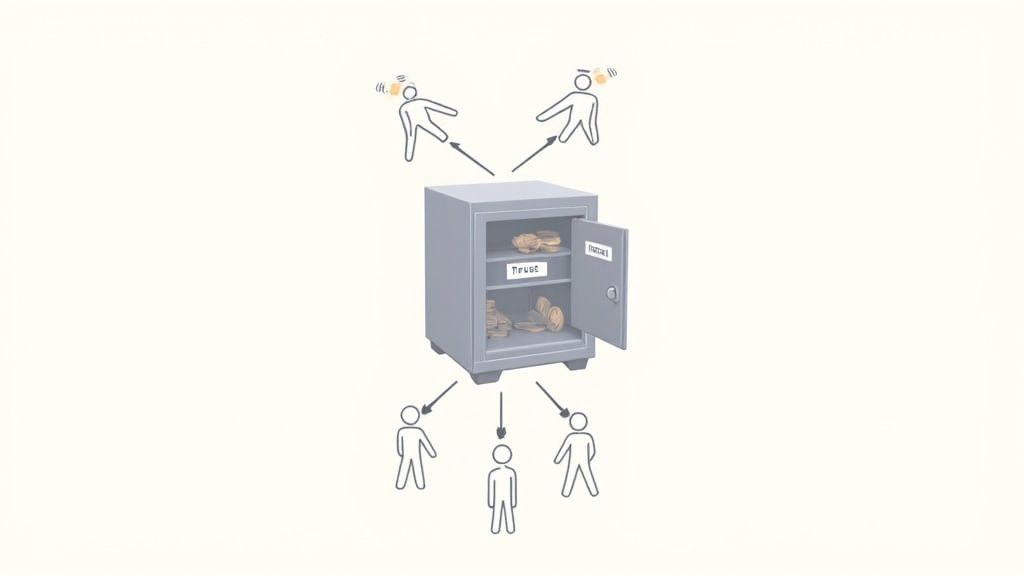
While a trust that retains a capital gain may not receive the full 50% discount, its power lies in distributing the gross capital gain to individual beneficiaries. Once distributed, the beneficiaries can then apply their personal 50% CGT discount, provided the 12-month holding period has been met by the trust. This creates a significant tax planning opportunity that is central to many wealth management strategies.
Practical Examples
Consider how this works in a real-world scenario:
- Family Discretionary Trust: A family trust holds an investment property portfolio and realises a capital gain of $300,000 from a sale. The trustee decides to distribute it. They could stream $150,000 of the capital gain to an adult child at university with no other income, and the other $150,000 to a spouse who works part-time. Each beneficiary could then apply their 50% CGT discount, making their respective assessable gains $75,000. This is taxed at their lower marginal rates, resulting in a far better tax outcome than if the gain was taxed in a single high-income earner's hands.
- Multi-Generational Wealth Planning: A long-standing family trust holds a diverse share portfolio. The trustee can strategically distribute capital gains to different generations based on their tax positions. This could involve distributing to retired parents (on a low tax rate) or adult children (on various marginal rates), depending on the family's overall financial goals.
Actionable Tips for Implementation
To effectively use a trust as part of your capital gains tax strategies in Australia, consider these steps:
- Ensure a Flexible Trust Deed: Your trust deed must provide the trustee with clear discretionary powers to stream different types of income (like capital gains) to different beneficiaries. Review your deed with a legal professional.
- Strategic Distribution Planning: Align distribution decisions with your end-of-financial-year tax planning. Assess each beneficiary's likely taxable income to determine the most tax-effective allocation of the capital gain.
- Document Decisions Correctly: Trustee resolutions detailing the distributions must be signed and dated before 30 June each year. Failure to do so can result in the trustee being taxed at the highest marginal rate.
- Seek Specialist Advice: Trust and tax law are complex. Engage an accountant and a lawyer experienced in trust administration to ensure compliance. You may want to explore more to understand what a discretionary trust is and how it can fit into your structure.
6. Primary Residence Exemption and Smart Property Sequencing
The main residence exemption is the most generous tax concession available to many Australian property owners. This rule allows you to sell the home you live in without paying any Capital Gains Tax (CGT) on the profit. For many Australians, the family home represents their largest asset, and this exemption can be a cornerstone of long-term wealth creation.
This strategy involves careful planning, especially when you own multiple properties or your living situation changes. The ATO has specific rules about what qualifies as a main residence, how long you must live there, and what happens if you use part of your home to produce income. Smart sequencing and designation of your primary residence can maximise the tax-free gains you are entitled to.
Practical Examples
Let's explore how this exemption works in practice:
- Standard Family Home: A family purchases an apartment in 2015 for $600,000 and lives in it as their main residence. In 2024, they sell it for $1.2 million, realising a capital gain of $600,000. Because the property was their main residence for the entire ownership period, the entire $600,000 gain is generally tax-free.
- Strategic Designation: An individual owns their home and an investment property. They decide to move into the investment property and rent out their former home. By living in the second property and establishing it as their main residence, they can potentially claim the full exemption on it when they sell, while the first property may have a partial exemption depending on the timing and application of the six-year absence rule.
- Working Overseas: A person who owns and lives in their home moves overseas for work for four years, renting out the property. They return, move back in for a year, and then sell. Under the 'temporary absence rule', they may still be able to claim the full main residence exemption, as their absence was less than six years and other conditions were met.
Actionable Tips for Implementation
To effectively utilise the main residence exemption, consider the following:
- Maintain Strong Evidence: Keep clear records that prove a property is your main residence. This includes utility bills, electoral roll registration, and evidence of where your personal belongings are kept.
- Apportion Use Carefully: If you use part of your home to run a business, you may only be entitled to a partial exemption. The portion of the property used for income-producing purposes will likely be subject to CGT.
- Understand the Six-Year Rule: You can generally treat a dwelling as your main residence for up to six years after you stop living in it, provided you do not nominate another property as your main residence. This is a powerful tool for those who move temporarily. For more detailed insights into property strategies, you can explore some smart moves for managing investment property.
- Plan Dual-Property Scenarios: If you and your spouse own different properties, you can generally only claim one property as the main residence for the same period. Coordinated planning is essential.
7. Timing of Asset Sales and Financial Year Planning
Strategic timing of when you realise a capital gain is a fundamental tax planning tool. This capital gains tax strategy involves consciously deciding which financial year to sell an asset, thereby controlling when the gain is included in your assessable income. The goal is to align the CGT event with a period of lower personal income, which may reduce the marginal tax rate applied to the gain. It is a proactive approach that requires foresight and an understanding of your complete tax position.
This strategy is based on the principle that your capital gain is added to your other income for the financial year. By deferring a sale to a future year when you expect lower income, or bringing it forward if you anticipate a higher income next year, you can directly influence your final tax liability.
Practical Examples
Let's explore how timing can impact tax outcomes:
- Planning for Retirement: A high-income earner on a 47% marginal tax rate plans to sell an investment property with a $300,000 capital gain. By waiting until the financial year after they retire, their income will be significantly lower. Realising the gain in retirement could drop their marginal rate to 34.5%. This deferral could potentially save them tens of thousands of dollars in tax.
- Variable Income Earners: A consultant with fluctuating yearly income can plan to sell shares during a year with lower revenue. This ensures the capital gain is not "bunched" on top of a peak income year, which would push more of the gain into the highest tax brackets.
- Coordinating with a Spouse: A couple can plan for the working spouse to realise a capital gain in the same year their partner is on parental leave with a lower income. If the asset is jointly held, this coordination can help manage the household's overall tax burden.
Actionable Tips for Implementation
To effectively time your asset sales, consider the following steps:
- Forecast Your Income: Project your expected income for the current and at least one future financial year. This is the foundation for making an informed timing decision.
- Understand Contract vs. Settlement: The CGT event typically happens on the date you enter into the contract of sale, not the settlement date. This timing dictates which financial year the gain will fall into.
- Assess Market Risk: While deferring a sale can save tax, it also means holding the asset for longer. You must weigh the potential tax benefits against the market risk that the asset's value could decline while you wait. Seek personal advice to balance these factors.
- Coordinate with Your Partner: Discuss your financial plans with your spouse or partner. A coordinated approach to realising capital gains across the household can unlock greater efficiencies.
8. Negative Gearing and Investment Asset Sequencing
While not a direct CGT reduction tool, negative gearing is a complementary strategy that can influence your overall after-tax return on investments. It occurs when the deductible expenses of an income-producing asset exceed the income it generates. This net loss can then be offset against your other assessable income, like your salary, reducing your tax bill for that financial year.
This approach works in tandem with capital growth. The annual tax deductions effectively subsidise the holding costs of a growth asset. When you eventually sell the asset, the capital gain you realise is the culmination of this long-term strategy. Viewing your portfolio holistically allows you to sequence the disposal of assets strategically to maximise your net wealth.
Practical Examples
Let's explore how this integrated approach functions:
- Investment Property: An investor owns a rental property. The combined mortgage interest and other deductible expenses total $30,000 for the year, while the rental income is only $24,000. This creates a $6,000 loss for the year. This $6,000 loss could be claimed as a tax deduction against their salary, reducing their income tax. When the property is eventually sold for a capital gain, that gain has been supported by years of tax relief on the holding costs.
- Share Portfolio: A business owner has a margin loan to fund a share portfolio. The interest on the loan amounts to $30,000 per year, while the dividend income is $20,000. This results in a net investment loss of $10,000. This loss can offset other business or personal income, providing an immediate tax benefit while the investor waits for the share values to appreciate.
Actionable Tips for Implementation
To integrate negative gearing with your capital gains tax strategies, consider these steps:
- Ensure Genuine Income Production: The ATO scrutinises investment deductions. The strategy is only valid for assets genuinely held for the purpose of producing assessable income.
- Maintain Impeccable Records: Diligently document all income and every deductible expense, including interest, council rates, and maintenance fees. This is crucial to substantiate your claims.
- Assess Cash Flow Impact: Negative gearing creates a cash flow deficit. Ensure you have sufficient income from other sources to comfortably cover this shortfall, particularly if interest rates rise.
- Strategic Sequencing: Plan the timing of asset sales carefully. Realising a capital loss from one asset could be used to offset a capital gain from another in the same year.
- Annual Professional Review: Your financial circumstances change. It is wise to review your investment loan structures and deductions annually with a tax adviser to ensure the strategy remains appropriate for your situation.
8-Point Comparison of Australian CGT Strategies
| Strategy | 🔄 Implementation complexity | ⚡ Resource & planning required | 📊 Expected outcomes | 💡 Ideal use cases | ⭐ Key advantages |
|---|---|---|---|---|---|
| Capital Gains Tax Discount (50% for individuals) | 🔄 Low — clear 12‑month rule | ⚡ Low — maintain purchase/sale records | 📊 Large reduction on long‑term gains; ⭐ High for individuals | 💡 Long‑held shares, investment property, business assets >12 months | ⭐ Simple to claim, broad application, substantial after‑tax boost |
| Capital Losses Harvesting and Carry‑Forward | 🔄 Medium — timing and netting rules | ⚡ Medium — systematic tracking and documentation | 📊 Offsets current/future gains; ⭐ Flexible across years | 💡 Market downturns, portfolio rebalancing, offsetting large gains | ⭐ Unlimited carry‑forward; defers or eliminates CGT when applied |
| Small Business CGT Concessions | 🔄 High — multiple eligibility tests | ⚡ High — professional advice, detailed records | 📊 Very large reduction or deferral; ⭐ Very high if eligible | 💡 Selling small business, retirement, succession planning | ⭐ Possible near‑elimination of CGT; rollover and retirement exemptions |
| Spousal Transfer Strategy | 🔄 Medium — must be genuine and market‑valued | ⚡ Medium — formal documentation and timing | 📊 Moderate family tax reduction; ⭐ Effective with income disparity | 💡 Shift gains to lower‑income spouse, retirement planning | ⭐ Leverages separate thresholds and marginal rates to reduce family tax |
| Trust Structures & Distribution Planning | 🔄 High — trust law and tax rules complex | ⚡ High — setup costs, compliance, adviser involvement | 📊 Significant tax efficiency via beneficiary allocations; ⭐ High for families | 💡 Family wealth splitting, centralized investment, multigenerational planning | ⭐ Distributes gains to low‑rate beneficiaries; asset protection and flexibility |
| Primary Residence Exemption & Property Sequencing | 🔄 Medium — nuanced residency/apportionment rules | ⚡ Medium — evidence, timing and record‑keeping | 📊 100% CGT exemption for main home; ⭐ Very high for homeowners | 💡 Selling main home, managing dual residences, tax‑free gains on sale | ⭐ Complete tax‑free treatment of main home; large potential savings |
| Timing of Asset Sales & FY Planning | 🔄 Medium — requires income forecasting | ⚡ Medium — coordinate settlements and income timing | 📊 Significant marginal rate savings when timed well; ⭐ High if income varies | 💡 Retirement, career transitions, years with lower income | ⭐ Tactical control over taxable year; relatively low implementation cost |
| Negative Gearing & Investment Sequencing | 🔄 Medium — ongoing cashflow and leverage management | ⚡ High — continuous monitoring, interest/cashflow management | 📊 Reduces taxable income via deductions; ⭐ Variable by performance | 💡 Investment property or margin‑loan share strategies in growth markets | ⭐ Deductions lower tax payable and can subsidize growth investments |
Your Next Step: From Knowledge to Action
Navigating Australian capital gains tax is an essential aspect of prudent wealth stewardship. Throughout this guide, we have explored a suite of capital gains tax strategies Australia has to offer, each providing a pathway to more effective financial management when your circumstances align. The journey from understanding these concepts to applying them requires diligence, foresight, and strategic planning.
Foundational principles, such as the 50% CGT discount for individuals and the strategic timing of asset sales, can have a direct impact on your net returns. These are not complex manoeuvres but rather disciplined actions that reward careful planning. Similarly, tax-loss harvesting is a vital tool, transforming an underperforming investment into a mechanism for offsetting gains elsewhere in your portfolio, thereby optimising your overall tax position.
Integrating Strategies into a Cohesive Plan
The true power of these strategies emerges not when they are applied in isolation, but when they are woven together into a cohesive, long-term financial plan. For instance:
- The main residence exemption is a dynamic tool that can be strategically sequenced with other property investments to maximise tax-free growth.
- For business owners, the Small Business CGT Concessions represent generous tax relief, but unlocking them requires meticulous record-keeping and a clear understanding of eligibility rules well before a sale.
- Trust structures offer flexibility in distributing capital gains, but their effectiveness is dependent on careful annual planning and adherence to the trust deed and tax laws.
Managing CGT is an active pursuit. It demands that you maintain immaculate records, understand the cost base of your assets, and appreciate how each financial decision creates a future tax consequence. This proactive stance transforms tax from a source of anxiety into a manageable component of your wealth creation journey.
From Strategy to Stewardship
Ultimately, mastering these principles is about becoming a more capable and confident steward of your resources. It is about ensuring that the value you have worked hard to build is preserved and can be deployed effectively to fund your future goals. The Australian tax system, while complex, provides these strategic avenues to encourage thoughtful investment and long-term planning.
Your responsibility now is to move from knowledge to considered action. Review your portfolio, assess your financial structure, and identify which of these strategies may be relevant to your personal objectives. Remember, the wisest financial decisions are born from a clear understanding of both the opportunities and the associated responsibilities. By applying these principles with discipline and seeking personal advice when your situation demands it, you equip yourself to navigate Australia's financial seasons with foresight and quiet confidence.
General Advice Warning: The information provided in this article is general in nature only and does not constitute personal financial advice. It has been prepared without taking into account your personal objectives, financial situation, or needs. Before acting on any information, you should consider the appropriateness of the information provided and the nature of the relevant financial product, having regard to your objectives, financial situation, and needs. We strongly recommend you seek independent professional advice before making any financial decisions.
Navigating the complexities of CGT requires a clear, strategic framework tailored to your unique circumstances. Everglow Prosperity specialises in creating holistic financial plans that integrate tax-effective strategies to help you build and protect your wealth with confidence. To see how these principles can be applied to your personal situation, explore our approach at Everglow Prosperity.
Want help applying this to your situation?
Every situation is different. Book a time with our team to talk it through, or call us on 1300 913 929.
Book a free meetingAustralian tax guide →Estimate your fees →
Keep exploring