

When an asset is sold for a profit in Australia, that financial success is often accompanied by a tax obligation known as Capital Gains Tax (CGT). This can feel like a complex area, but the tax system is designed with certain provisions that, when understood, can significantly reduce or even eliminate the tax payable. Thoughtful financial stewardship involves understanding these rules.
Among the most significant provisions are the main residence exemption, which generally protects the family home, and a suite of concessions designed to support small business owners. Understanding how these exemptions and concessions may apply is not merely about compliance; it is a fundamental aspect of sound, long-term financial management. This guide aims to provide a clear overview to support your financial journey.
Understanding the Framework of CGT Exemptions

When you dispose of an asset—such as property, shares, or a business interest—any profit or 'capital gain' may form part of your assessable income for that financial year. However, Australian tax law acknowledges that not all assets serve the same purpose. Certain assets play a unique role in our lives and the economy, and the rules reflect this.
The exemptions available are not loopholes. They are deliberate features of our tax legislation, established to support specific policy goals like encouraging home ownership and fostering a dynamic small business sector.
The Purpose Behind CGT Exemptions
At their core, these exemptions have a clear and practical purpose. The main residence exemption, for example, recognises that a family home is more than an investment; it is a place of security and stability. The system is structured to avoid penalising families who may need to move for work, accommodate a growing family, or downsize in retirement.
Similarly, the small business CGT concessions are intended to support entrepreneurship. They provide a pathway for business owners to sell their life's work without facing a prohibitive tax liability, often enabling them to fund a well-deserved retirement. For many local families and business owners, these concessions are a cornerstone of succession planning.
Key Exemptions to Consider
This guide will explore several key exemptions and concessions available under Australian tax law, breaking them down into clear, practical terms. We will cover:
- The Main Residence Exemption: How your family home may be fully or partially exempt from CGT.
- The Four Small Business Concessions: A suite of powerful tools for eligible business owners.
- Pre-CGT Assets: The rules for assets acquired before CGT was introduced on 20 September 1985.
- The 50% CGT Discount: A general discount for certain assets held for more than 12 months.
It is also important to note that your residency status can significantly affect which exemptions you may claim. The rules for a non-resident for tax purposes in Australia can be quite different, particularly concerning the main residence exemption.
Navigating these rules requires an understanding of both the opportunities they present and the responsibilities they entail. Diligent record-keeping and forward planning are not just best practice—they are essential for demonstrating eligibility.
The Main Residence Exemption: Protecting Your Family Home
For most Australian families, their home is the centre of their world—a place of security, memories, and the result of years of disciplined work. The Australian tax system acknowledges this special status through the main residence exemption, a cornerstone of our Capital Gains Tax (CGT) framework.
In simple terms, this exemption generally means that you may not have to pay CGT on any capital gain made from the sale of your family home. It is arguably the most powerful and widely used tax concession available to everyday Australians, ensuring that major life events do not necessarily come with an unexpected tax bill.
Eligibility and Practical Application
To be eligible for the full exemption, the property must genuinely be your main residence. This is a practical test based on facts: it is where you and your family live, where your personal belongings are kept, and the address you use for mail and on the electoral roll. The exemption generally covers the dwelling and adjacent land up to two hectares.
Of course, life is rarely straightforward, and the rules contain flexibility to account for real-world situations. The ATO provides clear guidance on these matters. For a broader look at principles applying to real estate, this resource on capital gains on property disposal may offer a useful starting point.
The Temporary Absence Rule
One of the most practical features of the main residence exemption is the temporary absence rule. This rule may allow you to move out of your home, earn income from it, and still be able to treat it as your main residence for CGT purposes upon sale.
Depending on your circumstances, you may be able to continue treating the property as your main residence for:
- Up to six years at a time if it is used to produce income (for instance, by renting it out).
- Indefinitely if it is not used to produce income.
This provision can be particularly useful for professionals on a temporary work placement interstate or overseas, or for a family wishing to travel for an extended period. A key condition is that during that absence, you do not treat another property as your main residence (with a minor exception for short periods when moving between homes). This tax treatment is distinct from other property types, as explored in our guide to holiday home tax deductions.
When a Partial Exemption May Apply
A full exemption is not always available. If you have used part of your home to produce income—for example, by running a business from a dedicated home office or seeing clients in a consulting room—you may only be eligible for a partial exemption.
Upon sale, a capital gain calculation may be required for the portion of the property used for business purposes and for the period of that use. This makes meticulous record-keeping an absolute necessity.
This rule ensures the system remains equitable. For example, consider a new migrant family who purchases a home to live in. If one partner, a Personal Services Income (PSI) earner, uses 15% of the home as a dedicated clinic for the entire ownership period, a portion of the capital gain on sale may become taxable. Research from the Australia Institute highlights the significant value of this exemption.
The Four Small Business CGT Concessions
For the owners of Australia's small and medium businesses, a sale is often the culmination of a lifetime of effort. The Australian tax system recognises this with a powerful suite of Capital Gains Tax (CGT) concessions designed to support business owners as they plan for succession or retirement.
These four concessions can, in some circumstances, be used together, offering a pathway to significantly reduce, defer, or even eliminate the tax otherwise payable on the sale of eligible business assets. They exist to help ensure a lifetime of building value can lead to a dignified and financially sound exit.
An Overview of the Concessions
Each of the four concessions serves a different purpose and is governed by its own set of rules. A common threshold is the maximum net asset value test. Generally, this means the net value of your CGT assets (plus those of any connected entities) cannot exceed $6 million just before the sale.
Developing an understanding of these rules is a critical step in strategic planning. For a broader look at the financial aspects of a business sale, this resource on navigating the tax implications of selling your business provides some valuable perspectives.
Here is a brief summary of the four key concessions:
- The 15-Year Exemption: This is the most complete concession. It may allow you to entirely disregard a capital gain if you are aged 55 or over and retiring (or are permanently incapacitated), and have continuously owned the active business asset for at least 15 years.
- The 50% Active Asset Reduction: This allows you to reduce the capital gain on an active asset by 50%. This may be applied after the general 50% CGT discount if you are also eligible for that.
- The Retirement Exemption: This may allow you to disregard capital gains up to a lifetime limit of $500,000. If you are under 55, the exempt amount must generally be contributed to a complying superannuation fund.
- The Small Business Rollover: This concession may allow you to defer a capital gain if you use the proceeds to acquire a replacement business asset or make a capital improvement to an existing one.
These rules provide a framework, but their application depends entirely on your specific circumstances. This underscores the need for careful planning well before a sale is contemplated.
To clarify the options, this table summarises the four concessions.
Overview of Small Business CGT Concessions
| Concession Type | Primary Benefit | Key Eligibility Condition Example |
|---|---|---|
| 15-Year Exemption | May disregard the entire capital gain. | Must have owned the asset continuously for at least 15 years. |
| 50% Active Asset Reduction | May reduce the remaining capital gain by 50%. | The asset must be an 'active asset' used in the business. |
| Retirement Exemption | May disregard gains up to a lifetime limit of $500,000. | If under 55, the exempt amount must go into a super fund. |
| Small Business Rollover | May defer the capital gain into a replacement business asset. | A replacement asset must be acquired within a specific timeframe. |
Understanding how these concessions may interact is where strategic value can be found.
How the Concessions Can Work Together
Let’s consider a practical example. A couple in their late 50s started a family manufacturing business 20 years ago. They decide it is time to sell the business assets to fund their retirement, triggering a capital gain of $1 million.
Because they have owned the business for over 15 years and are retiring, they could potentially use the 15-year exemption. This may allow them to disregard the entire $1 million capital gain, resulting in no CGT to pay. It is the most complete of the capital gains tax exemptions Australia offers business owners.
If they did not meet a specific condition for that exemption, they might still be able to apply other concessions in sequence. First, they could apply the general 50% CGT discount (if eligible), reducing the gain to $500,000. Next, the 50% active asset reduction could halve it again to $250,000. Finally, the retirement exemption could be used to disregard the remaining $250,000, again potentially resulting in no tax.
This illustrates that a good grasp of how to value a business for sale is just the first step in a much larger strategic process.
While on the topic of exemptions, this flowchart provides a simplified decision tree for the main residence exemption.
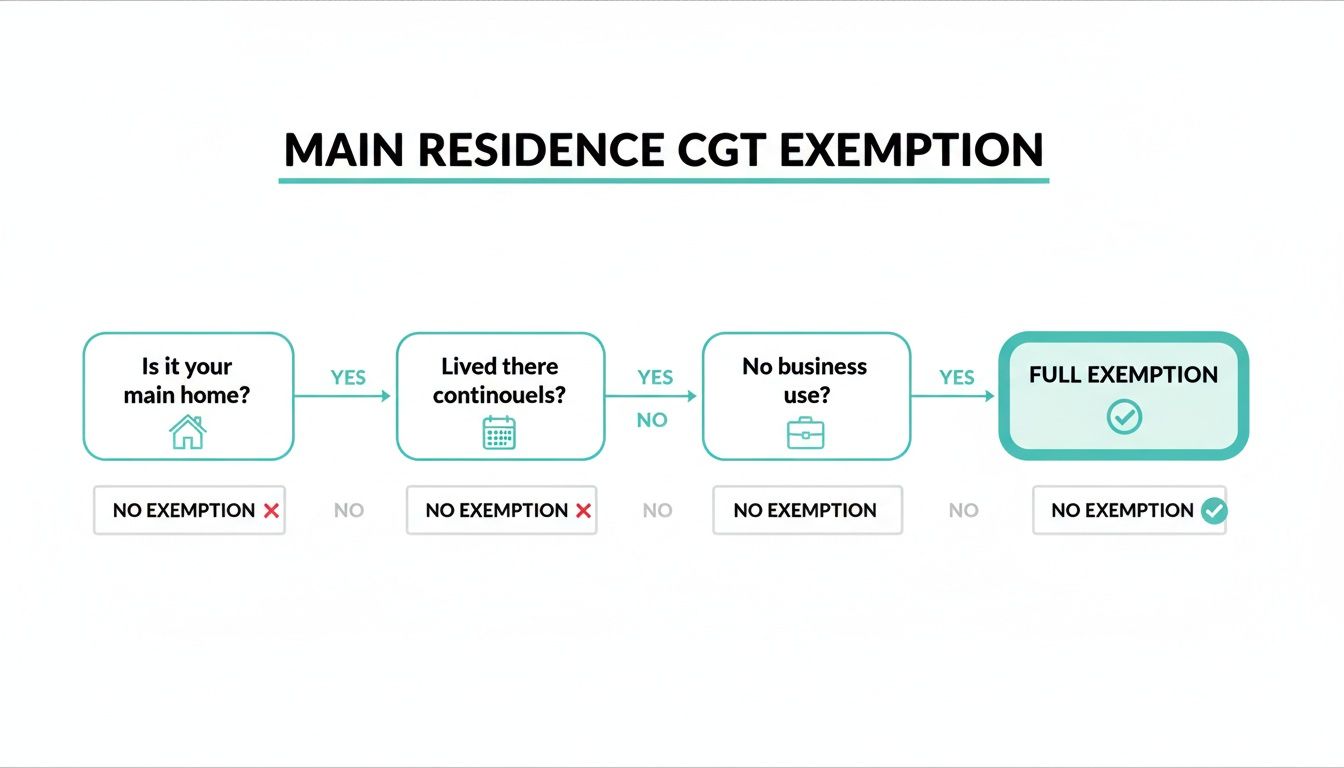
The flowchart shows the logical steps involved in assessing eligibility, reinforcing that each condition may need to be met for a full exemption to apply.
Since their introduction, these small business concessions have been significant for countless business owners. As research from the Australian Treasury has shown, these concessions exempt billions of dollars in capital gains annually, highlighting their economic importance.
Beyond the rules for your home and business, the Australian tax system has other important provisions that can shape your financial strategy. Taking the time to understand these can make a material difference to your Capital Gains Tax (CGT) position over the long term.
These rules cover specific types of assets and how long they have been held, recognising that not all gains are the same. Grasping these concepts is a key part of building a resilient financial plan.
Pre-CGT Assets
One of the most straightforward exemptions applies to assets acquired before the CGT system was established. If you acquired an asset before 20 September 1985, it is generally considered a ‘pre-CGT asset’.
When such an asset is sold, any capital gain is typically disregarded completely. This ‘grandfathering’ rule was a core part of the system’s design, shielding long-held assets from a tax that did not exist at the time of purchase. The responsibility, however, rests with you to keep clear records—such as contracts or valuation reports—that substantiate the acquisition date.
Personal Use Assets and Collectables
The tax system treats items owned for personal enjoyment differently from investments. The ATO has a specific category for personal use assets, which are items kept mainly for your personal use and enjoyment.
Common examples include:
- A boat used for family recreation.
- Furniture in your home.
- Household appliances.
If you acquired a personal use asset for less than $10,000, any capital gain you make when you sell it is generally disregarded. Conversely, any capital loss on a personal use asset cannot be used to offset other capital gains.
Collectables—such as artwork, jewellery, or antiques—are subject to their own specific rules. If you acquired a collectable for $500 or less, any capital gain is typically disregarded. If you paid more, any gain may be assessable, but capital losses from collectables can generally only be used to offset capital gains from other collectables.
These specific rules highlight the importance of your intentions and your records. How you acquire, use, and document an asset can have a significant impact on the tax outcome years later.
The 50% CGT Discount
This is perhaps the most widely used CGT concession. The 50% CGT discount may allow most Australian resident individuals and trusts to reduce their taxable capital gain by half (complying superannuation funds generally receive a one-third discount).
To qualify, you must generally hold the asset for at least 12 months before the disposal. This discount was introduced to encourage long-term investment over short-term speculation. As explained in discussions on the history of capital gains tax in Australia, it is now a central pillar of the CGT framework.
For example, a professional investor buys $40,000 of shares and sells them 18 months later for $60,000, realising a $20,000 capital gain. Because the shares were held for more than 12 months, the 50% discount could apply. This would reduce the taxable capital gain to $10,000, which would then be added to their assessable income for the year.
The structure used to hold assets also plays a role in eligibility, which is why understanding concepts like how trusts work can be a crucial part of prudent financial planning.
Risks, Responsibilities, and Planning
While the various capital gains tax exemptions Australia offers can provide significant financial relief, they are not automatic entitlements. Accessing these concessions comes with clear responsibilities, the most fundamental of which is diligent record-keeping.
In the view of the Australian Taxation Office (ATO), the obligation to substantiate eligibility for an exemption rests with the taxpayer. This extends beyond merely retaining a purchase contract; it means keeping organised records of acquisition costs, improvement expenses, periods of use, and any income an asset has generated. Without this evidence, substantiating a claim can be challenging.
Navigating Common Pitfalls
Several common scenarios can lead to unexpected tax outcomes if not managed with foresight. These are not systemic failures, but the result of complex rules applied to real-life situations.
Key areas where issues may arise include:
- Partial Main Residence Use: If part of your home was used to produce income, a portion of your capital gain may be assessable. The ATO requires a careful calculation based on factors like floor space and dates, which is difficult without precise records.
- Failing the 'Active Asset' Test: For business owners, a key gateway to the small business concessions is the 'active asset' test. An asset used primarily to derive rent, for example, may not qualify.
- Timing and Documentation: The structure of a sale and the timing of a claim can have lasting consequences. Understanding obligations around a tax due date is critical, as incorrect lodgements may attract penalties.
The Importance of Proactive Planning
Thoughtful planning is the bedrock of good financial stewardship. The decisions made when an asset is first acquired can have long-term implications for the tax outcome upon its eventual sale. This is not about seeking loopholes, but about structuring affairs in a compliant and sensible manner from the outset.
A financial strategy built on hope is not a strategy. A resilient plan is founded on a clear understanding of the rules, meticulous documentation, and an honest assessment of both risks and opportunities.
For instance, a business owner aiming for the 15-year exemption must ensure their asset continuously meets the active asset definition. A family planning to rent out their home while overseas needs to understand the limits of the six-year rule. Proactive planning transforms these rules from potential challenges into manageable components of a long-term strategy. Given the intricacies of tax law, seeking professional advice may be a prudent step.
Practical Next Steps
Navigating the landscape of capital gains tax exemptions is an exercise in disciplined, thoughtful stewardship. The rules discussed—from protecting your home to securing a business exit—are all built on the foundations of good record-keeping and proactive planning. Understanding the concepts is one thing; applying them with patience and foresight is where true value lies.
A Checklist for Prudent Planning
To translate this knowledge into practical steps, it may be helpful to methodically review your own circumstances. This is not about making hasty decisions, but about building awareness for the future.
Consider the following:
- Review Your Asset Records: Are the records for your key assets complete and accessible? Ensure you can clearly establish acquisition dates, costs, and any capital improvements.
- Assess Your Main Residence Status: Before contemplating a sale, consider how you have used your property. Does its use align with the main residence exemption rules?
- Evaluate Business Concession Eligibility: If you own a business, periodically reflect on your potential eligibility for the small business concessions. Understanding these rules long before a sale is contemplated can inform key strategic decisions.
The core message is that foresight is a valuable asset. The decisions you make today, particularly around how your assets are held and documented, can have consequences for years to come. Thoughtful planning builds financial resilience.
A Concise Takeaway
This guide has provided an overview of the significant capital gains tax exemptions Australia has to offer. The main residence exemption is designed to protect the family home, while the four small business CGT concessions provide a powerful framework for entrepreneurs.
When combined with the 50% CGT discount and other specific rules, a clear picture of the opportunities and responsibilities emerges. For a deeper look, our educational resources offer further context. Our team also provides detailed business and corporate advisory services to support these important decisions.
If you would like clarity on how these principles may apply to your own circumstances, you may wish to speak with a qualified adviser. You can contact Everglow on 1300 913 929 or email contact@everglow.au to arrange a discussion.
General Advice Warning: The information provided in this article is general in nature only and does not take into account your personal objectives, financial situation or needs. You should consider whether this information is appropriate for you before making any decisions. We recommend you seek personal financial, legal, and taxation advice before acting on any information in this article.
Want help applying this to your situation?
Every situation is different. Book a time with our team to talk it through, or call us on 1300 913 929.
Book a free meetingAustralian tax guide →Estimate your fees →
Keep exploring