

As a property investor in Australia, understanding the available tax deductions is a fundamental aspect of managing your assets. Two of the most significant—and often confused—are Capital Allowance and Capital Works.
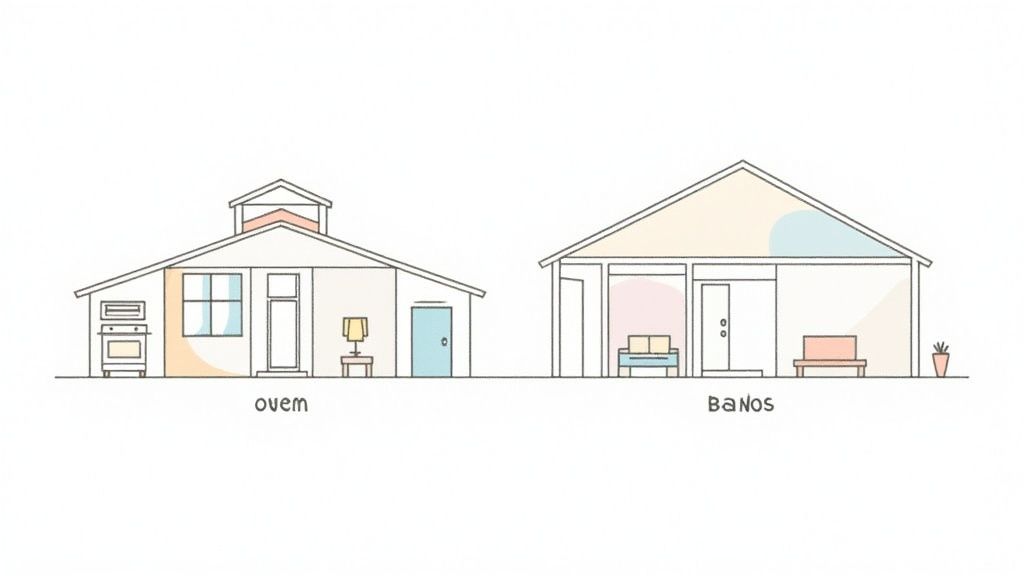
A simple way to view them is this: Capital Allowance (under Division 40 of the tax act) generally applies to items you can remove from the property. This includes assets like an oven, carpets, blinds, or an air conditioning unit. These items typically have a shorter lifespan and, as a result, their value may decline more quickly.
Conversely, Capital Works (under Division 43) relates to the fixed, structural elements of the building. This includes the foundations, walls, roof, and improvements such as a new deck or driveway. These are long-term deductions, claimed at a slower, steadier rate over decades.
Understanding Your Core Property Tax Deductions
For any diligent Australian property investor, grasping these two deductions isn't just about compliance; it's a cornerstone of effective financial management. These are not aggressive tax loopholes but established principles within Australian tax law, guided by the Australian Taxation Office (ATO).
Applying these deductions correctly helps build a resilient foundation for your investment journey. The ATO categorises these claims under two distinct divisions of the Income Tax Assessment Act 1997:
- Capital Allowance (Division 40): This covers the depreciation of what the ATO terms ‘plant and equipment’. These are essentially the removable assets that experience wear and tear over a shorter period.
- Capital Works (Division 43): This applies to the building's structure itself. It includes the original construction costs as well as structural improvements or extensions you might make over time.
Capital Allowance vs Capital Works At a Glance
While both deductions offer a way to reduce your taxable income, they function quite differently. The primary distinction lies in the nature of the asset and the rate at which you can claim its decline in value. These deductions are also separate from other common claims, and you can learn more about mortgage interest as a tax deduction in our detailed guide.
To provide clarity, here’s a simple breakdown of how the two compare.
| Attribute | Capital Allowance (Division 40) | Capital Works (Division 43) |
|---|---|---|
| Asset Type | Removable plant & equipment (e.g., ovens, air conditioners, carpets). | Fixed, structural components of the building (e.g., walls, floors, roof). |
| ATO Division | Governed by Division 40 of the ITAA 1997. | Governed by Division 43 of the ITAA 1997. |
| Depreciation Rate | Varies based on the asset's 'effective life' as determined by the ATO. | Generally a fixed 2.5% per year for eligible residential properties. |
| Claim Period | Over the specific effective life of each individual asset. | Typically over a 40-year period from the date of construction completion. |
Understanding this distinction is a critical first step. It helps ensure you are claiming your entitlements correctly and remaining compliant, which is the foundation of any sound property investment strategy.
Exploring Capital Works: Your Division 43 Deductions

While capital allowances cover removable items, capital works deductions are a different matter. Governed by Division 43 of the Income Tax Assessment Act 1997, this deduction relates to the building’s core structure—the enduring elements that provide its form and function.
Often called the 'building write-off', these deductions can provide a steady, long-term benefit. They are designed to account for the gradual decline in a building's structural value over its lifetime, offering a consistent claim for property investors and business owners.
Defining Capital Works Assets
Correctly identifying these assets is the first step to claiming with confidence. The Australian Taxation Office (ATO) defines capital works as the expenditure on constructing buildings and making structural improvements.
Unlike the diverse range of items under Division 40, these assets are almost always fixed to the property and cannot be easily removed. This may include:
- The original cost of constructing the building.
- Major renovations or alterations that fundamentally improve the property.
- Extensions, such as adding a new room, a garage, or a patio.
- Other structural improvements like retaining walls, sealed driveways, and fences.
It is this fixed, integral nature that separates a capital works claim from a capital allowance. For example, built-in kitchen cabinetry is a capital work, but a dishwasher installed within it could be considered plant and equipment. Making a clear distinction between capital allowance vs capital works is crucial for compliance.
The Claiming Framework
Capital works deductions are calculated using a fixed rate over a long period. For most residential rental properties, the rules are specific and predictable, which can assist with long-term financial planning.
The standard rate for a qualifying residential property is 2.5% per annum, claimed over a total of 40 years. This steady rate provides a predictable, non-cash deduction that may help manage your taxable income year after year. For a business owner with a commercial property, the rate might be 4%, depending on when the building was constructed and its use.
This methodical approach to depreciation reflects the long life of a building’s structure. It is a testament to careful, patient wealth building, allowing investors to claim a portion of their largest capital outlay in a disciplined manner over decades.
Eligibility and Key Dates
A critical aspect of Division 43 deductions is the construction commencement date. For most residential rental properties, construction must have started after 15 September 1987.
This date is a firm line drawn by the ATO. Properties built before then are generally not eligible for the 2.5% building write-off on their original construction cost. However, substantial renovations completed after this date may still qualify for a claim. This is why obtaining accurate records or a quantity surveyor’s report is not just a good idea—it can be a necessity for proper financial stewardship.
For instance, the ATO clarifies how an investor could claim these deductions on a townhouse with a construction cost of $500,000. In this scenario, the investor could claim a yearly deduction of $12,500 ($500,000 × 2.5%), showing the consistent, long-term benefit of correctly applying Division 43 rules. You can find more ATO examples and guidance on their official property and land investments page.
Diving into Capital Allowances: Your Division 40 Deductions
While capital works deductions under Division 43 cover the enduring structure of a property, we now turn to their counterpart: capital allowances. Governed by Division 40 of the Income Tax Assessment Act 1997, this is where we deal with what the ATO calls ‘depreciating assets’—or what many of us know as plant and equipment.
These are the individual items within your property that wear out over time. Unlike the building's fixed structure, these assets are generally removable, have a much shorter lifespan, and are subject to direct wear and tear from use.
What Counts as a Depreciating Asset?
The key distinction for a Division 40 asset is that it is not part of the building's primary structure. For property investors and business owners, these items are common and may represent a significant opportunity for tax deductions, provided they are identified and valued correctly.
Common examples of depreciating assets that may qualify for capital allowances include:
- Appliances: Ovens, cooktops, dishwashers, and rangehoods.
- Fixtures: Carpets, vinyl flooring, curtains, and blinds.
- Climate Control: Air conditioning units and ceiling fans.
- Ancillary Items: Hot water systems, smoke alarms, and garage door motors.
Each of these is treated as a separate asset by the ATO. This is a critical point in the capital allowance vs capital works discussion. Instead of depreciating one building at a single, slow rate, you may have many individual assets, each depreciating on its own, faster schedule.
The Power of "Effective Life"
The core of Division 40 deductions is the concept of effective life. This is the period the ATO determines an asset can be used for producing income. The tax office publishes detailed rulings that specify the effective life for hundreds of different assets, providing a clear framework for claims.
For example, the ATO might rule that carpets have an effective life of 10 years, while a hot water system is set at 12 years. This means you may be able to claim the decline in their value over these specific periods.
A potential advantage here is that the depreciation rates for Division 40 assets are often much higher than the flat 2.5% for capital works. This could deliver larger deductions in the early years of owning a property, which may improve your cash flow when it is most needed.
This approach reflects reality. An oven or an air conditioner will almost certainly need replacing long before the building's foundations or roof. Capital allowances acknowledge this by focusing on these shorter-lived assets. This differs from the slow-and-steady capital works deduction; the rates for plant and equipment depend on the asset itself, often allowing for faster write-offs. You can find more details on these kinds of Australian corporate tax deductions and how they are structured.
Because every asset has its own value and effective life, creating an accurate depreciation schedule is a specialist task. This is why a qualified quantity surveyor is often considered essential. They can inspect the property, identify each qualifying asset, and assign a specific value and effective life to each one. For anyone serious about managing an investment property, this is not an optional extra; it is a fundamental part of good stewardship. A professionally prepared schedule provides a roadmap to compliant and maximised deductions for years to come.
Comparing Division 40 and Division 43 Side by Side
Understanding the theory behind Capital Works and Capital Allowances is one thing; seeing how they compare is another. For a property investor, this distinction is not merely academic—it has a real impact on your tax position year after year.
This side-by-side comparison explores the practical differences that matter. We will break down the asset types, the depreciation rates, and what it all means for your financial position. This is not about deciding which one is 'better.' It is about understanding how they must work together as part of a disciplined and compliant investment strategy.
Asset Nature: The Fundamental Divide
The most crucial difference comes down to the nature of the assets themselves. Understanding this helps everything else—from the rate of depreciation to the claim period—fall into place.
Capital Works (Division 43) assets are the permanent, fixed structure of the building. Think of them as the building’s skeleton; they are integrated and not designed to be easily removed or replaced. This includes things like:
- Foundations, walls, floors, and the roof
- Built-in cupboards and doors
- Structural improvements like adding a new room or a permanent deck
In contrast, Capital Allowance (Division 40) assets are the items within that structure. These are what the ATO calls 'plant and equipment'—things that are generally removable, wear out with use, and have a much shorter lifespan.

Items like ovens, carpets, and air conditioners are clearly separate from the building’s core structure, so the ATO treats them differently for tax purposes.
Depreciation Rates and Cash Flow Impact
The next key difference is the rate at which you can claim their decline in value, which directly affects your annual tax position.
Capital works deductions are very consistent. For a qualifying residential property built after 15 September 1987, you can generally claim a deduction at a fixed rate of 2.5% per year on the construction cost. This provides a slow, steady, and predictable deduction over its 40-year lifespan.
Capital allowances operate differently. Each asset has its own 'effective life' set by the ATO, leading to varied depreciation rates. An oven might depreciate over 12 years, while carpets might be written off over 10. These shorter lifespans mean higher annual depreciation rates, which can deliver larger tax deductions in the early years of owning a property.
The front-loaded deductions from Division 40 can be a powerful tool for improving cash flow, especially right after you’ve bought an investment. This needs to be balanced against the steady, reliable claims from Division 43, which provide the long-term foundation of your tax strategy.
Detailed Comparison of Capital Allowance and Capital Works
To make these differences crystal clear, let's lay them out in a simple table. This is a handy reference for any investor wanting to get a firm grip on their obligations and opportunities.
| Comparison Point | Capital Works (Division 43) | Capital Allowance (Division 40) |
|---|---|---|
| Asset Type | Fixed, structural parts of the building (e.g., walls, roof, foundations). | Removable plant and equipment (e.g., ovens, carpets, blinds). |
| Governing Law | Division 43 of the Income Tax Assessment Act 1997. | Division 40 of the Income Tax Assessment Act 1997. |
| Depreciation Rate | Generally a fixed 2.5% per year (for qualifying residential property). | Variable rates based on the specific 'effective life' of each asset. |
| Claim Period | Over 40 years from the date construction was completed. | Over the individual effective life of each separate asset. |
| Cash Flow Impact | Provides a steady, predictable deduction over the long term. | May provide larger, front-loaded deductions in the early years. |
| Identification Method | Requires historical construction costs, often determined by a quantity surveyor. | Requires a detailed asset register with individual values, prepared by a quantity surveyor. |
Ultimately, there is no substitute for a professionally prepared tax depreciation schedule. It is the only way to accurately separate and value these assets in a manner that satisfies the ATO. A qualified quantity surveyor will meticulously inspect a property, identify every qualifying item under both divisions, and produce a report that will form the basis of your claims for decades. This is not an area for guesswork; it is a foundational piece of responsible property investment. For a deeper look at managing your property’s financials, consider reviewing our guide on smart moves for your investment property.
How These Deductions Play Out in the Real World

Tax rules on paper only become meaningful when applied to real-world situations. The way capital allowance and capital works deductions interact can change significantly depending on the property, its age, and how it is used.
These scenarios bring the theory to life, showing how different Australians—from a local family investing in property to a business owner fitting out a new office—might navigate these claims. Each example grounds the rules in everyday situations and highlights why careful, tailored planning is essential.
Scenario 1: The Local Family and a New Investment Home
Let’s consider a family in Sydney buying a brand-new house to rent out. The purchase price covers the land, the building structure, and all the new fittings and fixtures. From a tax perspective, they have acquired a mix of Division 43 and Division 40 assets.
Their capital works (Division 43) claim is relatively straightforward. Because the house was built after 1987, they can claim 2.5% of the building’s construction cost each year for 40 years. It’s a steady, predictable deduction that can support their long-term financial planning.
The house is also full of new depreciating assets. This is where a quantity surveyor is invaluable. They can identify every eligible item and assign a value, creating a detailed schedule for the family's capital allowance (Division 40) claims.
This schedule might include:
- The oven, cooktop, and dishwasher in the kitchen.
- The carpets in the bedrooms and the blinds on the windows.
- The reverse-cycle air conditioning system.
Each of these items typically depreciates faster than the building itself. This may result in larger deductions in the early years of ownership, which could be a significant help when mortgage costs are at their highest.
Scenario 2: The Business Owner Fitting Out a Commercial Office
Now, let's turn to a business owner in Brisbane who has leased an empty commercial office. She needs to fit it out with new offices, a reception area, and staff facilities. Her spending will likely be a mix of both capital works and capital allowances.
The permanent, structural elements fall under capital works. This could cover building internal walls, installing fixed ceilings, and laying permanent flooring. These are structural improvements, and they may be depreciated at the commercial rate under Division 43, which is often 2.5% or 4% depending on the circumstances.
On the other hand, the assets she installs within that fit-out are claimed as capital allowances. This is where she can claim for a wide range of items essential for running her business.
Examples of Division 40 assets here could include:
- Desks, chairs, and filing cabinets.
- The telephone system and computer network cabling.
- Removable partitions and kitchenette appliances.
The crucial difference here is that the business owner does not own the building—only the fit-out. Her claims are based entirely on the improvements she funds, making the line between structural additions (Division 43) and removable equipment (Division 40) absolutely critical.
For both property investors and business owners, the initial classification of an asset determines its tax treatment for decades to come. A mistake made at the outset can have long-lasting financial consequences, underscoring the importance of getting it right from day one.
Scenario 3: The New Migrant and Their First Investment Property
Finally, imagine a professional who recently migrated to Australia and buys an established Melbourne apartment built in 2005 as their first investment. They are keen to follow all rules and know they need a depreciation schedule.
Their capital works claim is based on the apartment's original construction cost, which a quantity surveyor can estimate. The 2.5% annual deduction may apply from the day they begin renting it out.
The challenge, however, often lies with the capital allowance claims. Due to legislative changes in 2017, for second-hand residential properties, you generally cannot claim depreciation on existing plant and equipment.
This means they may not be able to claim for the oven, carpets, or air conditioner that were already in the apartment when they bought it. However, if they were to replace the old oven with a new one, the cost of the new appliance would be a new asset, and they could claim a capital allowance deduction for it. Learning these nuances is a vital part of responsibly managing an investment property.
As these examples show, there is no one-size-fits-all answer in the capital allowance vs capital works debate. Your personal situation, the property's history, and your intentions for it will always shape the appropriate strategy.
Common Pitfalls and Why Professional Guidance Is Crucial
Navigating the tax landscape requires an understanding of the risks as well as the opportunities. When it comes to capital allowance versus capital works, even diligent investors can make simple errors that create complications down the line. Often, these mistakes arise from a well-intentioned desire to minimise costs, but they may end up being far more costly in the long run.
The path to sound financial stewardship is grounded in discipline and detail. A calm, measured approach, supported by expert knowledge, is your strongest defence against future ATO complications.
Misclassification of Assets
One of the most common errors is putting an asset in the wrong category—confusing Division 40 (Capital Allowance) with Division 43 (Capital Works). An investor might, for example, incorrectly claim the entire cost of a new kitchen as a repair or, conversely, lump everything under the slow 2.5% capital works rate.
In reality, a kitchen renovation is often a blend of both. The structural elements like new cabinetry and plumbing changes may fall under Division 43. However, the new oven, dishwasher, and rangehood are distinct Division 40 assets, each with its own effective life and depreciation rate. Misclassifying these can lead to claiming an incorrect deduction amount, which is a clear flag for the Australian Taxation Office (ATO) and may result in a revised tax assessment and potential penalties.
DIY Valuations and Cost Estimates
Another frequent misstep is attempting to estimate construction costs or asset values without professional input. While it might seem like a shortcut, the ATO requires figures to be properly substantiated. You cannot simply invent a figure for the construction cost of a property built 20 years ago or assign a random value to the carpets and blinds.
A professionally prepared tax depreciation schedule is an act of responsible stewardship. The modest upfront investment provides an independent, defensible, and accurate basis for your claims, ensuring peace of mind and long-term compliance.
A qualified quantity surveyor is recognised by the ATO as having the specific expertise to value original construction costs and to identify and value individual depreciating assets. Their report serves as your evidence. Without one, you could leave yourself open to having your claims questioned or even denied during an ATO review. This is especially critical for those managing holiday homes, where rules around income-producing use are particularly strict. You can find a detailed overview in our guide to holiday home tax deductions.
Ultimately, the goal is not to aggressively minimise tax but to apply the law correctly. Professional guidance helps ensure your financial foundation is solid, compliant, and built for enduring stability.
Understanding the difference between capital allowances and capital works is not about finding clever loopholes. It’s about applying Australian tax law correctly to strengthen your financial position in a compliant, measured way.
The principles discussed here provide a foundation for your thinking. However, wise financial stewardship always requires disciplined planning and professional guidance tailored to your specific circumstances. The core difference in the capital allowance vs capital works debate comes down to the asset type and its depreciation rate—details that must be identified correctly from the start.
The most prudent takeaway is this: ensure your financial journey is built on a solid, compliant base. Patience and careful planning are the cornerstones of enduring prosperity, turning complex obligations into manageable strategies that support your long-term goals.
Making informed decisions starts by acknowledging what you don’t know. Whether you are a business owner, a family investing for the future, or a new migrant building a life in Australia, seeking advice ensures your strategy aligns with both your goals and your responsibilities. This careful approach is the most reliable path to building lasting financial stability.
General Advice Warning: The information in this article is general in nature and has been prepared without taking into account your personal objectives, financial situation, or needs. Before acting on any information, you should consider its appropriateness in light of your own circumstances and seek professional advice.
Want help applying this to your situation?
Every situation is different. Book a time with our team to talk it through, or call us on 1300 913 929.