

For many Australians, the idea of a self-managed super fund (SMSF) often arises from a desire for greater control, expanded investment flexibility, and more tailored tax planning opportunities. These potential benefits provide a sound reason for some to take a more direct role in managing their retirement savings. This guide explores these aspects with a steady hand, focusing on the practical realities and responsibilities involved.
What Is an SMSF and Is It Appropriate for You?
Viewing your superannuation as the foundational capital for your financial independence is a useful perspective. A Self-Managed Super Fund (SMSF) is a private superannuation fund structure that allows you to take a hands-on role in building that foundation. It places you in direct control of how your retirement assets are invested and managed, guided by a clear legal framework.

In this structure, you and up to five other members become the trustees, responsible for making all investment decisions in line with your documented strategy and legal obligations.
However, this level of autonomy comes with significant responsibilities. As a trustee, you are legally required to navigate the complexities of Australian tax law and superannuation regulations. The Australian Taxation Office (ATO) acts as the regulator, and compliance is not optional.
The Core Structure of an SMSF
At its heart, an SMSF is a trust where the members are also the trustees. This dual role is its defining feature, meaning you are personally accountable for the fund's compliance and performance. To operate, the fund must have its own Tax File Number (TFN), Australian Business Number (ABN), and a dedicated bank account.
Key characteristics include:
- A Small Membership: An SMSF can have between one and six members, making it a potential option for families or business partners who may wish to pool their superannuation assets.
- Trustee Responsibility: Every member of the fund must generally be a trustee (or a director of a corporate trustee), making them equally responsible for all decisions and compliance.
- An Investment Strategy: You are legally required to formulate, implement, and regularly review a comprehensive investment strategy. This document must articulate how you will manage risk, returns, diversification, liquidity, and the insurance needs of the members.
Is an SMSF Suitable for Your Circumstances?
Deciding to establish an SMSF requires an honest assessment of your financial situation, your skills, and the time you are willing to commit. This is not a passive investment. It is a path often considered by those with a substantial super balance, as the fixed running costs may become more economical compared to the percentage-based fees charged by some retail or industry funds.
An SMSF places the responsibility for compliance squarely on the trustees. This includes everything from meticulous record-keeping and arranging an annual audit to ensuring every action aligns with the sole purpose test—which is strictly about providing retirement benefits for its members.
A sound understanding of the self-managed super fund rules is a legal requirement. Before proceeding, it may be prudent to ask whether you have the financial acumen and dedication to manage the fund’s affairs diligently over the long term. This guide will walk through the potential benefits to help you decide if this structure aligns with your financial vision.
Gaining Control Over Your Investment Strategy
One of the most compelling reasons individuals consider an SMSF is the level of investment control it may offer. Instead of being limited to a pre-selected menu of options from a large fund, you have the ability to build a portfolio from the ground up—one that reflects your financial strategy, risk appetite, and long-term objectives.
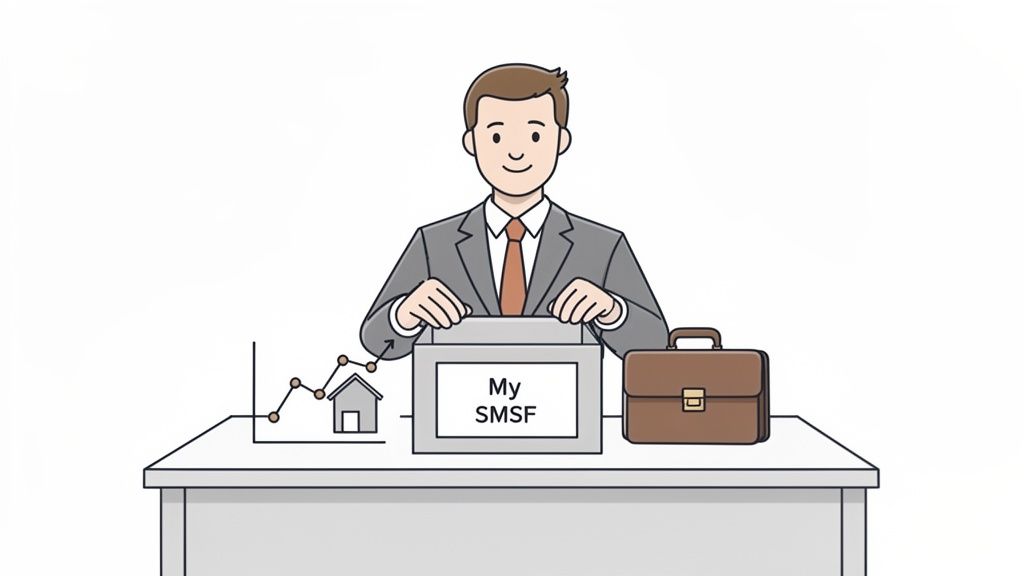
This direct control allows for a level of precision that is not always possible in larger superannuation funds. It may open the door to a wider universe of assets, moving beyond the typical managed funds that form the bedrock of many default superannuation products.
A Broader Investment Universe
With an SMSF, the investment possibilities can expand significantly, always guided by your fund’s formal investment strategy and prevailing superannuation law. The potential advantage is the ability to design a portfolio that aligns with your risk profile, sector expertise, and tax position.
This flexibility means your portfolio could potentially include:
- Direct Australian and International Shares: You can select individual companies, rather than investing solely in a broad index fund.
- Direct Property: This can include both residential and commercial real estate, though it is subject to strict borrowing, acquisition, and usage rules.
- Unlisted Assets: Investments in unlisted companies or certain managed funds may become accessible, depending on your strategy and risk tolerance.
- Other Assets: Depending on your fund’s strategy, this could extend to assets like precious metals, though these come with very stringent regulations regarding storage and valuation.
The difference in control is notable when compared with other types of funds.
Comparing Investment Control: SMSF vs APRA-Regulated Funds
This table highlights some of the key differences in investment choice between a Self-Managed Super Fund and a typical APRA-regulated fund.
| Feature | Self Managed Super Fund (SMSF) | Industry / Retail Super Fund |
|---|---|---|
| Investment Choice | Trustees choose specific assets: individual shares, properties, etc., guided by a documented strategy. | Members choose from a pre-set menu of investment options (e.g., Balanced, Growth, Conservative). |
| Direct Property | Permitted under strict rules, including using a loan (LRBA) to acquire eligible property. | Generally not possible to purchase a specific, direct property. |
| Asset Purchase/Sale Timing | Trustees decide precisely when to buy or sell assets to manage tax or respond to market conditions. | A fund manager makes buy/sell decisions for the entire pool of assets. |
| Portfolio Customisation | Highly customisable to match trustee expertise, values, and specific financial goals. | Limited to the available options; less ability to tailor to individual circumstances. |
As the table suggests, the SMSF structure places you in the driver's seat, allowing for a more hands-on and strategic approach to building retirement wealth.
The Responsibility of Control
This freedom, however, is balanced by significant responsibility. As a trustee, you are legally accountable for every decision. All investments must comply with your fund's documented investment strategy and the sole purpose test, which mandates that the fund is maintained only to provide retirement benefits to its members.
For example, a marketing agency owner who recently migrated to Australia might use an SMSF to invest in a portfolio of ASX-listed companies she understands well. Her decisions must be documented and justified within the fund’s investment strategy, demonstrating due diligence and a long-term retirement focus.
Decisions must be made with care, often requiring a level of financial literacy and time commitment that goes beyond what is needed for a standard super fund. The path of direct investment rewards thoughtful planning and disciplined action. If you require support in navigating these responsibilities, exploring our integrated SMSF services may provide a useful framework.
A More Active Role in Tax Strategy
Beyond investment choice, a significant benefit of an SMSF can be the ability to take a more active role in tax planning. This is not about seeking loopholes, but about utilising the structure of the superannuation system with a level of precision that may be difficult to achieve in a large public fund. This control allows for deliberate, timely decisions that can have a material impact on the fund's net returns over time.
The Transition to Retirement Phase
A key milestone for any super fund is when a member transitions from the accumulation phase to the retirement phase. Within an SMSF, this can be managed with precision.
When a member commences a retirement phase income stream, the investment earnings and any realised capital gains on the assets supporting their pension generally become tax-free. This is a cornerstone of the Australian superannuation system. In an SMSF, trustees have the control to specifically identify which assets support this tax-free income stream, subject to the transfer balance cap.
This means you can strategically structure the fund to shelter your highest-growth assets from future tax. The ability to manage this transition thoughtfully is a key reason why many consider an SMSF.
Opportunities for Business Owners
For business owners, an SMSF may present a particularly useful opportunity: the ability to hold the business’s own business real property inside superannuation. This allows the super fund to become the landlord for the commercial premises from which the business operates.
For example, a family-run professional services firm could have their SMSF acquire their office building. The business would then lease the premises from the SMSF at a commercial market rate. Under current law, the rent paid by the business is typically a tax-deductible expense, while the rental income received by the SMSF is taxed at the concessional superannuation rate of 15% during the accumulation phase. This creates a stable, tax-effective rental income stream for retirement.
This strategy demands watertight legal agreements, an independent market valuation, and careful structuring to ensure full compliance with ATO requirements.

Strategies for Consideration
With appropriate professional advice, SMSF trustees may consider more refined techniques tailored to their circumstances.
- Asset Segregation: This involves allocating specific assets to support different members or accounts within the fund. For example, high-growth shares could be allocated to support a member already in the tax-free retirement phase. This requires careful record-keeping to satisfy ATO requirements.
- Managing Capital Gains: As a trustee, you decide when to sell an asset. This allows you to time a sale to potentially offset a capital gain with a loss from another investment, or to defer selling an asset until a member moves into the retirement phase, where the capital gains tax may be reduced to nil.
These strategies are not "set and forget." Their suitability depends entirely on personal circumstances and requires expert advice to ensure compliance. The potential benefits are earned through years of careful, compliant, and well-advised management.
Understanding the Risks and Responsibilities
While the benefits of an SMSF can be compelling, this structure requires a genuine commitment of time and attention. It is essential to weigh the potential advantages against the significant duties involved. A clear-eyed view of both sides of the ledger is critical before making any decision.
The annual costs are generally fixed—covering administration, accounting, the independent audit, and the ATO supervisory levy. For those with a substantial super balance, this may be more cost-effective over the long run than the percentage-based fees charged by some large super funds, where fees can increase as your balance grows. The true cost, however, is also your own time and the responsibility for every decision the fund makes.
Key Trustee Responsibilities
When you become a trustee, you accept significant legal obligations. Any failure to comply can lead to serious penalties from the ATO. Your core duties include:
- Acting in Members' Best Interests: Every decision must be made for the sole purpose of providing retirement benefits for the fund's members.
- Annual Audit: You must appoint an approved SMSF auditor to conduct an independent audit of your fund each financial year.
- Record Keeping: You must keep meticulous records of all transactions, decisions, and meetings for a minimum of five to ten years, depending on the document.
- Lodging Annual Returns: An SMSF tax and regulatory return must be lodged with the ATO each year.
The role of a trustee is a fiduciary one, demanding a high standard of care. It involves not just making sound investment choices but also ensuring the administrative and legal integrity of the fund is maintained at all times.
Practical Next Steps
If the idea of managing your own super fund aligns with your financial goals, the path forward should be taken with careful consideration. The first step is an honest assessment of your current superannuation, your long-term retirement plans, and the time you can dedicate to managing the fund’s affairs.
The heart of an SMSF is the responsibility you accept. A disciplined and well-advised approach is essential to ensure the fund remains a compliant and effective vehicle for your retirement savings.
Perhaps the most crucial step of all is seeking professional guidance. The decision to establish an SMSF should not be made in isolation. An integrated team of advisers—spanning financial planning, tax, and legal—can provide a clear, 360-degree view of how this structure may fit into your broader financial life. Sound financial decisions come from understanding risks as well as potential benefits. The right advice will illuminate both, ensuring you proceed with clarity and confidence.
Concise Takeaway
An SMSF offers significant potential for control over investments and tax strategy but comes with equally significant legal and administrative responsibilities. It is a structure best suited to those with the time, financial acumen, and discipline to manage their retirement savings actively and compliantly over the long term.
If you would like clarity on how these principles may apply to your own circumstances, you may wish to speak with a qualified adviser. You can contact Everglow on 1300 913 929 or email contact@everglow.au to arrange a discussion.
General Advice Warning: The information provided in this article is general in nature and does not take into account your personal objectives, financial situation, or needs. Before acting on any information, you should consider the appropriateness of the information having regard to your own objectives, financial situation, and needs and seek personal advice from a qualified financial adviser.
Want help applying this to your situation?
Every situation is different. Book a time with our team to talk it through, or call us on 1300 913 929.