

If you are a contractor, consultant, or specialist professional in Australia, you may have encountered the term Personal Services Income, or PSI. It is a critical tax concept to understand, yet it can often be a source of confusion.
At its core, PSI is income generated primarily from your personal skills, knowledge, or effort. This may be thought of as the payment you receive for your unique expertise or labour, rather than for supplying goods or using specialised equipment.
The Australian Taxation Office (ATO) established the PSI rules to promote fairness in the tax system. The rules are designed to ensure individuals do not use a company or trust structure solely to split their personal income and achieve a tax outcome that would not be available to a regular employee earning a similar amount.
Foundations of Personal Services Income

Navigating the world of contracting often leads to a fundamental question: is the income I am earning considered Personal Services Income? Answering this correctly is a practical first step toward managing your finances with confidence and ensuring your affairs are structured appropriately.
Understanding this is not just about satisfying an ATO requirement; it is about building a solid foundation for your business. It allows you to structure your affairs correctly, understand your obligations, and make informed decisions with a long-term perspective.
The 50% Principle
The main test the ATO applies is often referred to as the 50% principle.
If more than 50% of the income you receive for a specific contract is a reward for your personal skills and labour, then all the income from that contract is generally considered PSI.
Let's examine a table to see how this might apply in different circumstances.
Quick Comparison of PSI and Business Income Scenarios
| Scenario | Primary Income Source | Potential ATO Classification | Reasoning |
|---|---|---|---|
| An IT consultant is paid to design a new software architecture. | The consultant's strategic knowledge and coding expertise. | Personal Services Income (PSI) | The value is almost entirely from the individual's personal skills and effort. |
| A builder is contracted to construct a new outdoor deck. | A mix of labour, project management, timber, and building materials. | Business Income (not PSI) | If materials and equipment costs make up over 50% of the invoice, the income may not be primarily for personal effort. |
| A freelance graphic designer creates a new logo for a client. | The designer's creativity, artistic skill, and experience. | Personal Services Income (PSI) | The client is paying for the designer's unique creative talent, not for goods or equipment. |
| A small earthmoving business digs foundations for a house. | The use of heavy machinery (excavator) and the operator's labour. | Business Income (not PSI) | A significant part of the value comes from the use of substantial business equipment, not just personal labour. |
This comparison highlights the core distinction the ATO makes. The focus is on what the customer is truly paying for: your personal expertise, or a combination of goods, equipment, and labour.
Who Is Commonly Affected by PSI Rules?
While PSI can apply to almost any industry, it is most common in professions where the individual is the service. These are roles where the value is intrinsically tied to personal expertise.
This often includes professionals like:
- Information Technology Consultants engaged for their coding, cybersecurity, or system architecture skills.
- Medical Practitioners and allied health professionals providing patient care through their own company or trust.
- Engineers and Project Managers whose primary value is their technical oversight and management expertise.
- Marketing and Media Professionals offering strategic advice, copywriting, or creative services.
The core principle of the PSI rules is to ensure that income which is predominantly a reward for an individual's personal efforts is taxed to that individual. This may prevent the diversion of personal exertion income to other entities simply to obtain a tax benefit.
For example, if a doctor operating through a company earns $250,000, and $225,000 (90%) of that income is from their direct expertise in treating patients, the ATO may view the entire $250,000 as PSI. This income is then "attributed" back to the doctor personally for tax purposes. You can find more insights on personal income from the ABS.
Recognising whether your income falls under the PSI rules is not about creating undue complexity. It is an essential step toward navigating the system with clarity and purpose.
Navigating the Personal Services Business Tests
If your income is determined to be personal services income (PSI), this is an important checkpoint, but not necessarily the final one. The next critical question is whether the more restrictive PSI rules apply to you. This hinges on one thing: are you operating a Personal Services Business (PSB)?
If you can demonstrate that you are running a genuine PSB, you may be treated like a normal business for tax purposes and operate outside the limitations of the PSI regime. It is helpful to view this as a series of gateways to pass through—a methodical process that rewards careful record-keeping and a clear understanding of how your business operates.
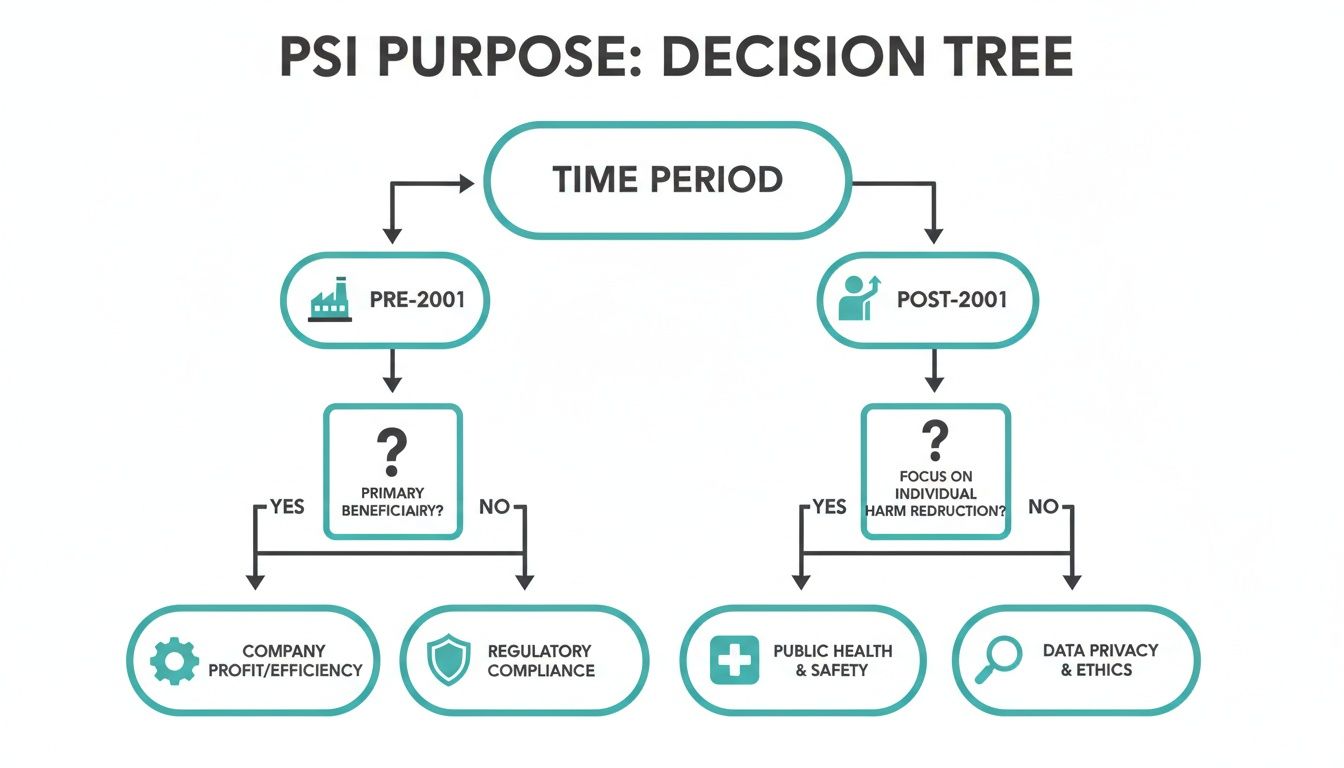
The focus of the rules is squarely on the individual earning the income. This makes the PSB tests the crucial hurdle to clear to be recognised as a standard business.
The Results Test
The first and most direct path to qualifying as a PSB is the Results Test. If you can pass this test for at least 75% of the PSI you earn in a year, you may not need to consider the others. To do so, you must satisfy all three of these conditions:
- You're paid for a result: Your contract is based on delivering a specific outcome, not just billing for your time.
- You provide your own tools: You supply the essential equipment or tools needed to complete the work.
- You're liable for defects: You are responsible for rectifying any errors in your work, at your own cost.
A classic example could be a software developer paid a fixed fee to deliver a functioning app. If they use their own computer and software, and their contract states they must fix any bugs found after launch, they are being paid for the result and carry the risk. This may be considered a clear pass.
The 80% Rule and Further Tests
If you do not pass the Results Test, the process becomes more layered. The next checkpoint is the 80% rule. If 80% or more of your PSI comes from a single client (and their associates) in a financial year, you generally cannot self-assess as a PSB using the remaining tests. In this situation, you may need to apply directly to the ATO for a special determination.
However, if your income is more spread out and no single client makes up 80% of it, you can move on to the next set of tests. You only need to pass one of these to qualify as a PSB.
The purpose of these subsequent tests is to demonstrate you are running a genuinely independent business, not simply an employee-like arrangement.
The Unrelated Clients Test
This test is about showing you have a public-facing business. You need to receive PSI from two or more clients who are not related to you or each other. Crucially, you must have secured this work by making offers to the public—for example, through advertising, your business website, or a public tender process.
Imagine a marketing consultant with a professional website who lands projects with three different, unconnected companies during the year. They are actively seeking work from the wider market, which points towards an independent business. While you might be working for yourself, the structure matters. It can be useful to contrast this with the simpler model of a sole trader in Australia.
The Employment Test and Business Premises Test
If you have not passed the Unrelated Clients Test, there are two final gateways:
The Employment Test: You may pass this if you hire others to perform at least 20% (by market value) of the core work. This has to be for the main service you provide, not just incidental administrative support.
The Business Premises Test: You may meet this if you own or lease business premises that are physically separate from your home. The space must be used exclusively for your work for the entire year.
A significant part of passing any of these PSB tests comes down to your contracts. The details in your agreements can be pivotal, so it is important to understand how they are drafted. Passing just one of these tests may be enough to show you have the hallmarks of a real business, potentially allowing you to operate outside the main PSI rules.
The Consequences of Attributed Personal Services Income
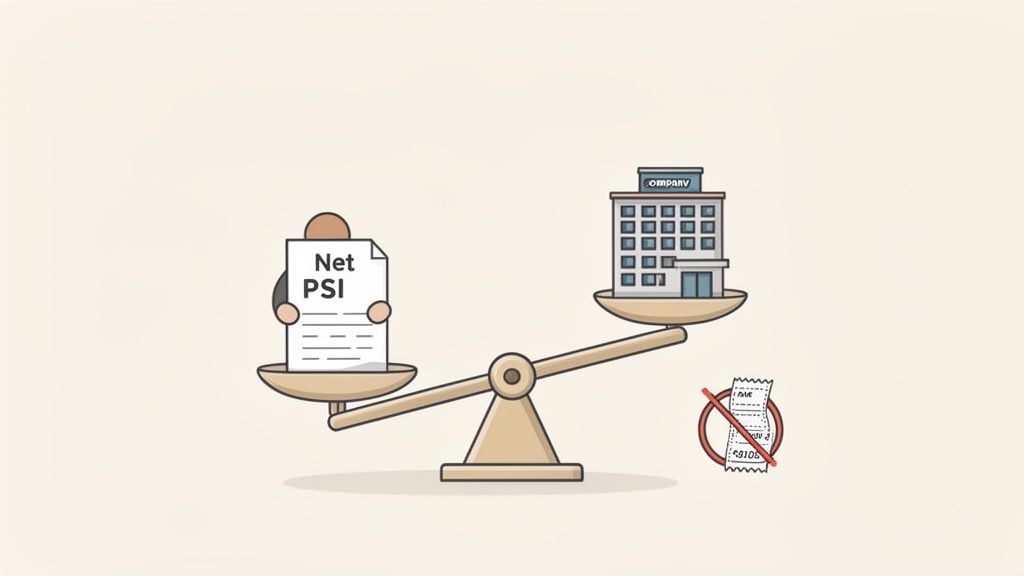
When your income is PSI and your structure does not pass the tests to be a personal services business (PSB), the tax treatment of that income changes. The rules are designed to align your income with that of an employee’s salary for tax purposes.
This is not a penalty; it is about tax fairness. The ATO’s goal is to ensure that income earned from personal skill and effort is taxed in the hands of the person who did the work. Understanding these consequences is key to planning effectively and remaining compliant.
There are two major consequences to be aware of: how the income is taxed (income attribution) and what you can claim as a deduction (deduction limitations).
Income Attribution: The Core Principle
The most immediate change is that the net PSI your company or trust earns is attributed directly to you—the individual who performed the services. The income cannot be left in the business structure to be taxed at the corporate rate or split among beneficiaries of a trust.
Instead, that profit must be paid out to you as a salary and declared on your personal tax return for that financial year. It is then taxed at your personal marginal rate, just as if you were an employee.
In essence, attribution is the mechanism that prevents a company or trust from being used as a tax shelter for personal exertion income. The ATO’s position is that the income belongs to the person whose skill generated it, and it must be taxed accordingly.
This is a critical point for anyone operating through a company or trust. Many of the standard tax planning strategies available to other businesses may no longer be available. To fully grasp why, it can be helpful to understand the basics of these structures, such as how trusts work in Australia, which highlights why the PSI rules are such a specific and powerful exception.
Limitations on Tax Deductions
The second major consequence affects your bottom line: your ability to claim tax deductions becomes more restricted, bringing them into line with what a typical employee could claim.
The general rule of thumb is: if an employee cannot claim it, your company or trust probably cannot either. This can have a significant impact on how you manage your business expenses.
Commonly denied deductions include:
- Payments to associates: You generally cannot claim a deduction for wages or superannuation paid to an associate (like a spouse or family member) for work that is not central to earning the income, such as handling basic administration or bookkeeping.
- Home-based business expenses: Certain costs for your home office, such as a portion of your rent, mortgage interest, or council rates, are typically not deductible against PSI.
- Superannuation for associates: Super contributions for an associate doing non-principal work are also generally disallowed as a deduction for the business.
A Practical Australian Example
Let's place this in a real-world context. Imagine Maria, an IT contractor working through her company, Innovate IT Pty Ltd. This financial year, she invoices $150,000 for her services. Her income is classified as PSI, and she does not pass any of the PSB tests.
First, her company cannot retain the profit. After paying legitimate business costs like her professional indemnity insurance, the net income must be attributed to Maria. It will be added to her personal tax return and taxed at her individual marginal rate.
Second, Maria pays her spouse a salary to manage her calendar and handle invoicing. Because this is considered non-principal work, the PSI rules prevent Innovate IT Pty Ltd from claiming a tax deduction for that salary.
Understanding these consequences is not just about compliance; it is about accurate financial forecasting. If you are uncertain how these rules apply to your circumstances, seeking guidance from specialist tax advisers may be a prudent step.
Managing Risks and Responsibilities
Operating as an independent professional offers great freedom, but it also comes with clear responsibilities. Navigating the rules around personal services income is about building a resilient and sustainable business. Sound financial decisions come from understanding risks as well as potential benefits.
A significant risk is misclassifying your income. If the Australian Taxation Office (ATO) reviews your structure and determines you have misclassified your income, the consequences could include amended tax assessments, back-taxes, interest, and penalties. A proactive and disciplined approach is your best defence.
Good stewardship of finances involves patience, disciplined action, and thoughtful planning over time. By understanding and meeting your obligations, you are reinforcing the structural integrity of your business and safeguarding your financial future.
Key Compliance Obligations for Attributed PSI
When the PSI rules apply, your company has specific duties. These exist to ensure the tax system remains fair for everyone, whether they are a traditional employee or a contractor.
Your key responsibilities may include:
- Attributing the Income: The net PSI your company receives must be promptly attributed to the individual who earned it and reported on their personal tax return.
- PAYG Withholding: Your company may need to register for PAYG withholding and remit tax to the ATO from the payments made to the individual.
- Reporting: An annual PAYG payment summary (now known as an income statement) may need to be issued to the individual and reported to the ATO.
- Superannuation Guarantee: The company will also have an obligation to make Superannuation Guarantee (SG) contributions for the individual based on the income they earned.
Meeting these obligations requires diligent record-keeping and a clear understanding of the rules from the outset. This can transform compliance from a source of stress into a routine aspect of your professional life, allowing you to focus on your core work.
If you would like clarity on how these principles may apply to your own circumstances, you may wish to speak with a qualified adviser. You can contact Everglow on 1300 913 929 or email contact@everglow.au to arrange a discussion.
General Advice Warning: The information provided in this article is general in nature and does not take into account your personal objectives, financial situation, or needs. Before acting on any information, you should consider the appropriateness of the information in regard to your own objectives, financial situation, and needs, and seek professional advice.
Want help applying this to your situation?
Every situation is different. Book a time with our team to talk it through, or call us on 1300 913 929.
Book a free meetingAustralian tax guide →Estimate your fees →
Keep exploring