

Determining if you are an Australian resident for tax purposes is a foundational question that may shape your entire financial relationship with the country. It is a matter that requires careful consideration and a clear understanding of the principles set out by the Australian Taxation Office (ATO).
It is important to recognise that your tax residency status is a concept distinct from your citizenship or visa. This status is the primary factor that determines how you are taxed in Australia and on what income.
Why Your Tax Residency Status Matters
Understanding your tax residency is a critical first step in managing your financial affairs in Australia. This is not merely an administrative detail; it directly impacts your financial obligations and opportunities, and getting it right provides a stable foundation for sound financial planning.
Depending on your circumstances, your residency status may determine:
- Which income is assessable: Australian residents are generally taxed on their worldwide income. In contrast, foreign residents are typically taxed only on income sourced in Australia.
- The tax rates applied: Residents may benefit from marginal tax rates and, importantly, the tax-free threshold. You can explore our resources to better understand what the tax-free threshold means.
- Your Medicare levy obligations: Residents are usually required to pay the Medicare levy, which helps fund Australia’s public healthcare system.
A Matter of Fact and Circumstance
It is vital to understand that tax residency is not a choice. It is a determination based on the facts of your individual circumstances. The ATO considers a range of factors to ascertain the reality of your connection to Australia.
Factors such as your physical presence, your family and business ties, and your intentions and purpose in Australia all play a role in this assessment.
For professionals, business owners, and new migrants, clarifying this status from the outset is an act of good financial stewardship. It provides the clarity needed to plan effectively, meet compliance obligations, and build a secure financial future with confidence.
Overlooking this crucial detail could lead to incorrect tax filings and potential complications with the ATO. A thoughtful and early assessment helps ensure you are meeting your responsibilities and are correctly positioned within the Australian tax system.
Later in this guide, we will walk through the four key tests the ATO uses to make this determination.
The Four ATO Residency Tests: A Practical Breakdown
The Australian Taxation Office (ATO) uses a series of tests to determine your residency status. You only need to satisfy one of the four tests to be considered an Australian resident for tax purposes.
Understanding these tests is a cornerstone of sound financial management. Each one examines your connection to Australia from a different perspective, focusing on the substance of your circumstances rather than just your visa or passport.
At its core, being a resident generally means your worldwide income is assessable in Australia. Being a foreign resident generally means only your Australian-sourced income is. This flowchart illustrates that fundamental distinction.
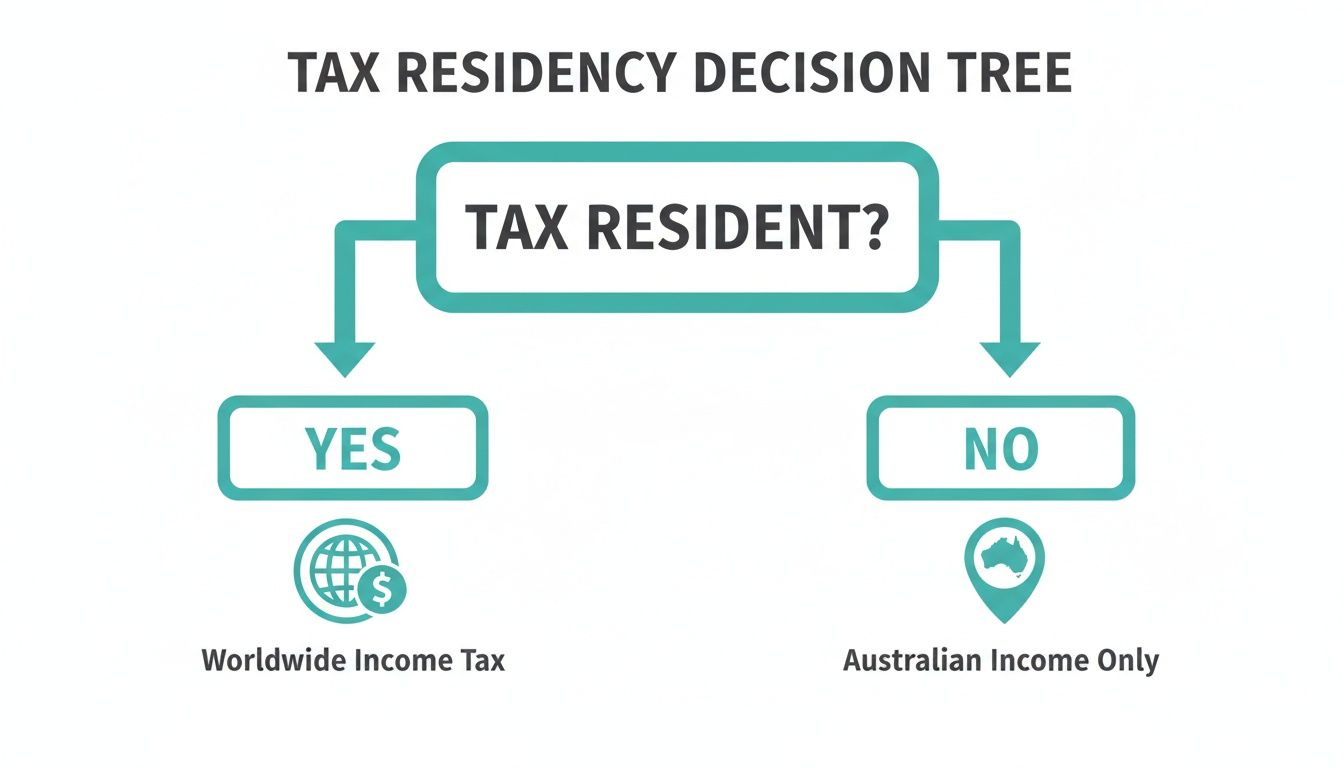
This single determination—resident or foreign resident—has significant implications for how your income is taxed.
1. The Resides Test
This is the primary test. It asks whether you reside in Australia according to the ordinary meaning of the word. This is about more than a postal address; it considers the nature and quality of your physical presence in the country.
The ATO may look at a combination of factors, including:
- Physical Presence: The amount of time you spend in Australia.
- Intention and Purpose: Your reason for being in Australia.
- Family and Business Ties: The location of your immediate family and your main business or employment interests.
- Maintenance of a Home: Whether you own or rent a place in Australia that is your established home.
For example, a professional who moves their family to Perth on a four-year work contract, leases a home, and enrols their children in a local school is likely demonstrating an intention to live in Australia for that period. In such circumstances, they may be considered a resident under this test.
2. The Domicile Test
This test relates to your domicile—your legal home base. By law, you acquire a domicile at birth.
You may be considered a resident if your domicile is in Australia, unless the ATO is satisfied that your permanent place of abode is outside Australia. "Permanent" in this context does not necessarily mean forever; it suggests you have settled and established a home in another country.
A key consideration here is the nature of your life overseas. If you are travelling from place to place without establishing a settled home, it may be difficult to demonstrate that you have a permanent place of abode elsewhere.
3. The 183-Day Test
This test is often a point of confusion. It states you may be a resident if you are physically present in Australia for more than half the financial year—that is, 183 days or more, whether continuously or intermittently.
However, this is not an automatic rule. You could be in Australia for longer than 183 days and still be a foreign resident if your usual place of abode is outside Australia and you do not intend to take up residence here.
Consider an IT contractor from overseas working on a specific eight-month project in Sydney. If their family, home, and social life remain firmly in their home country, they may not be considered a resident, despite their presence exceeding 183 days. Their ties and intentions could clearly indicate their usual home is elsewhere. We explore similar situations in our guide on taxes in Australia for expats.
4. The Commonwealth Superannuation Test
This is the most specific test and applies to a narrow group of people, primarily Australian government employees working at Australian posts overseas.
If you are a member of certain Commonwealth government superannuation schemes, you (and your spouse and children under 16) are generally considered an Australian resident for tax purposes. This rule is designed to ensure Commonwealth public servants representing Australia abroad remain within the Australian tax system.
Risks and Responsibilities: How Residency Impacts Your Tax
Understanding whether you are an Australian resident for tax purposes is not just an academic exercise. The outcome has direct and significant financial implications, shaping your obligations to the Australian tax system. It dictates what income you must declare, the tax rates you pay, and your eligibility for certain benefits. Highlighting these differences underscores both the opportunities and the responsibilities that come with your status.
For an Australian tax resident, the scope is generally broad. You are typically taxed on your worldwide income. This means income from all sources—whether from employment in Melbourne, rent from a property in Manchester, or dividends from US shares—may need to be declared in Australia. This global approach reflects your economic connection to the country.
In contrast, a foreign resident usually has a more limited obligation. You are typically taxed only on income sourced from within Australia. This might include wages from local employment or rental income from an Australian investment property. The tax system acknowledges that your primary financial life is centred elsewhere.

Key Financial Differences
The most immediate impact is often seen in tax rates and thresholds. An Australian resident may benefit from progressive tax brackets, which include the tax-free threshold. For the 2023-24 income year, this means you could earn up to $18,200 before paying income tax.
Foreign residents generally do not receive this benefit. They typically pay tax from the first dollar of Australian-sourced income they earn, often at a different set of rates.
This distinction is a cornerstone of financial planning. For a resident, the tax-free threshold provides a valuable buffer, whereas a foreign resident must account for tax being levied on their Australian-sourced earnings from the outset.
Furthermore, residents are also usually required to pay the Medicare levy. As a foreign resident, you are generally exempt. These differences reinforce why a correct determination of your status from the beginning is so important for responsible financial stewardship.
Resident vs. Foreign Resident Tax Obligations
This table provides a clear comparison of how residency status can shape your financial duties. Remember that sound financial decisions come from understanding risks as well as potential benefits, and your residency is key to both.
| Tax Obligation | Australian Resident | Foreign Resident |
|---|---|---|
| Taxable Income | Worldwide income | Australian-sourced income only |
| Tax-Free Threshold | Yes (currently $18,200) | No |
| Medicare Levy | Generally payable | Generally exempt |
| Tax Rates | Progressive marginal rates | Different rates may apply |
| Capital Gains Tax | May access concessions and the main residence exemption. | Rules may differ, especially for property. Learn more about foreign resident capital gains withholding. |
While this table serves as a guide, personal circumstances can add layers of complexity. It is the interaction of your life with these rules that defines your position, reinforcing the need for a careful and considered assessment of your own situation.
Practical Next Steps
Determining your tax residency requires organised preparation and thoughtful record-keeping. This groundwork is a key part of good financial stewardship and is essential before you can confidently understand your position.
The first practical step is to gather documents that help tell the story of your circumstances and intentions. This is not about finding a single piece of evidence but about building a complete and transparent picture for the ATO.
Preparing Your Documentation
Start by assembling a file that includes evidence of your physical presence, accommodation, and financial ties. This collection of documents may be used to substantiate your position if required.
Items you may wish to collate include:
- Travel Records: Detailed records of your travel, such as flight confirmations and passport stamps, can help establish your physical presence in and out of Australia.
- Accommodation Details: Property leases, mortgage documents, or utility bills in your name for addresses in Australia and overseas can help clarify where you maintain a home.
- Financial and Employment Ties: Employment contracts, bank statements, and details showing where your significant assets are located can provide insight into your financial connections.
Double Taxation Agreements
For individuals with ties to more than one country, it is possible to be considered a resident of both countries under their respective domestic laws. This is where Double Taxation Agreements (DTAs) become relevant. Australia has treaties with over 40 countries to prevent double taxation and provide certainty.
A DTA includes a set of tie-breaker rules to determine which country has the primary right to tax your income. These rules often consider factors like where you have a permanent home or where your economic and personal ties are closer. Understanding these agreements is particularly important for globally mobile professionals and new migrants.
Concise Takeaway
Determining if you are an Australian resident for tax purposes is a nuanced process that considers the whole of your circumstances. The ATO weighs your intentions, physical presence, and genuine connections to Australia to form a complete view.
Achieving clarity on your residency status is a critical step in sound tax planning and long-term financial wellbeing. It allows you to manage your obligations, access the correct treatment under tax law, and make informed financial decisions with quiet confidence. Patient record-keeping, disciplined analysis, and seeking professional guidance where needed are all hallmarks of good financial stewardship.
Ultimately, your residency status reflects your unique story. Taking the time to understand its implications is an investment in your financial future, ensuring you are building on a solid and compliant foundation. For those with complex international ties or changing circumstances, professional advice may be appropriate to navigate these rules. Our team offers a range of advisory and tax services to provide tailored support. You can learn how to start a conversation with us via our contact page.
If you would like clarity on how these principles may apply to your own circumstances, you may wish to speak with a qualified adviser. You can contact Everglow on 1300 913 929 or email contact@everglow.au to arrange a discussion.
General Advice Warning: The information provided in this article is general in nature and does not take into account your personal objectives, financial situation, or needs. You should seek personal advice from a qualified professional before making any financial decisions.
Want help applying this to your situation?
Every situation is different. Book a time with our team to talk it through, or call us on 1300 913 929.