
A Self-Managed Super Fund (SMSF) represents a different approach to preparing for retirement. It places you in the role of trustee, making you directly responsible for the fund’s decisions. This is a significant shift from being a member of a large public fund where investment and strategy are managed on your behalf. For a growing number of Australians, the key advantages of an SMSF are found in this control—it may open the way for greater investment flexibility and more tailored tax and estate planning.
Why Australians Are Choosing to Manage Their Own Super
Opting for an SMSF is a fundamental change in how you engage with your retirement savings. It is a private super fund that you and up to five other members manage directly. This hands-on approach often appeals to seasoned professionals, business owners, and families who wish to take a more active role in their financial future.
The move to an SMSF is typically driven by the desire for strategies that a 'one-size-fits-all' fund may not accommodate. The primary reasons people consider this path usually involve:
- Investment Control: The freedom to select specific assets, from direct property and shares to other investments, that align with your long-term financial goals and risk tolerance.
- Tax Management: The ability to implement more precise tax strategies, depending on your circumstances. We explore some of these concepts in our guide to self-managed super fund rules.
- Estate Planning: The potential to create specific and legally sound arrangements for passing your superannuation wealth to the next generation.
Of course, this is not a small undertaking. Taking on the role of trustee means accepting significant legal and administrative duties, all overseen by the Australian Taxation Office (ATO).
The infographic below illustrates the scale of the SMSF sector in Australia, showing total assets, member numbers, and its portion of the entire superannuation system.

These figures demonstrate that SMSFs are a major, well-established part of Australia's retirement landscape. According to the ATO, as of September 2025, over 1.2 million members were managing $1.07 trillion in assets across 661,384 funds.
This represents approximately 24% of Australia’s total superannuation assets. It is a clear indicator of the trust placed in this structure, particularly among those with the financial experience and account balance to make it a considered and worthwhile strategy. You can discover more insights from the ATO’s statistical report.
Gaining Direct Control Over Your Investment Strategy
One of the most compelling advantages of a self-managed super fund is the direct control it may offer over your retirement savings. For many Australians, this is the primary reason for making the change. You shift from being a passive member in a large, standardised fund to becoming the active steward of your own financial future.
This allows you to chart a course that may be precisely aligned with your personal goals, values, and risk tolerance. This control is not just a concept; it can translate into tangible investment choices that may not be available in mainstream super products.
A Broader Universe of Investment Choices
With an SMSF, you could build a portfolio from the ground up, selecting individual assets you understand and believe in for the long term. Subject to the rules of the Superannuation Industry (Supervision) Act 1993 (SIS Act), a wider array of investment opportunities may become accessible.
Depending on your fund's formal investment strategy, you could consider assets like:
- Direct Property: This may include both commercial and residential real estate. A properly structured SMSF can acquire an investment property, though this is governed by strict rules, particularly around borrowing.
- Shares and Equities: You could invest directly in Australian and international shares, exchange-traded funds (ETFs), and listed investment companies (LICs), giving you granular control over the companies you support.
- Unlisted Assets: For experienced investors, this might include investments in unlisted companies or private equity ventures, tapping into specific industry knowledge.
- Other Assets: The scope could also include term deposits, bonds, and precious metals, provided they meet strict ATO regulations.
This flexibility allows for a genuinely personalised approach. For instance, some trustees may wish their retirement savings to reflect their personal ethics. Taking the time to understand how to align your portfolio with your values can be a worthwhile exercise in stewardship.
The core principle of an SMSF is that it empowers you, as a trustee, to construct a portfolio from the ground up. The responsibility for its performance—and its alignment with your retirement goals—rests entirely with you.
Practical Examples of Investment Control in Action
How might this control translate into a real-world strategy? Let’s look at a couple of scenarios relevant to Australian professionals and business owners.
A medical specialist running her own practice might see an opportunity. Using her SMSF, she could potentially purchase the commercial premises her practice operates from. Her practice would then pay rent to the SMSF at the market rate. This action could transform a major business expense into a reliable income stream for her retirement fund, subject to all relevant laws being met.
Or, consider a software developer who has spent a decade in the tech industry. They might identify a promising, unlisted start-up they believe in. Through their SMSF, they could make a direct investment, applying their deep industry expertise to an asset class they understand intimately. This kind of specific, knowledge-driven investing may not be possible in a large public fund.
The Cornerstone of Control: Your Investment Strategy
This freedom is not absolute; it is balanced by a profound legal duty. Every SMSF is required by law to have a formal, written investment strategy. This is not a mere formality but the foundational document that must guide every single investment decision you make.
The ATO and ASIC are very clear that this strategy must be reviewed regularly and must thoughtfully consider:
- Diversification: The need to spread investments across different asset classes to manage risk.
- Risk and Return: A realistic assessment of the potential risks and likely returns of your fund's investments.
- Liquidity: Ensuring the fund has enough cash flow to meet expenses and pay benefits as they fall due.
- Insurance Needs: A specific consideration of whether members hold appropriate life and TPD insurance cover.
Gaining this level of control can be empowering, but it also means taking full ownership of your financial outcomes. It requires diligence, patience, and a firm commitment to sound, long-term decision-making.
Leveraging Tax Strategies for Your Retirement
One of the significant advantages of an SMSF is the potential for more effective tax planning. While the same superannuation laws apply to every fund in Australia, an SMSF gives you the control to make decisions that could lead to more favourable tax outcomes over the long run, depending on your circumstances.
With a large public fund, your investments are pooled with thousands of others, and tax events happen at a fund-wide level. With an SMSF, you are able to align the fund’s investment decisions with your personal circumstances. This is not about finding loopholes; it is about thoughtfully navigating the structure of the system.
The Two Phases of Super: Accumulation vs. Retirement
The tax treatment inside superannuation operates in two distinct phases, and understanding this shift is central to prudent planning.
During your working years, in the accumulation phase, your fund's investment earnings are generally taxed at a concessional rate of up to 15%. For many professionals and business owners, this is a notable advantage compared to the marginal tax rates they may pay on personal income.
The situation changes when you meet a condition of release and move into the retirement phase to draw a pension. At this point, the investment earnings that support your income stream typically become tax-free. It is this transition from a 15% tax environment to a 0% one that opens the door for strategic decisions.

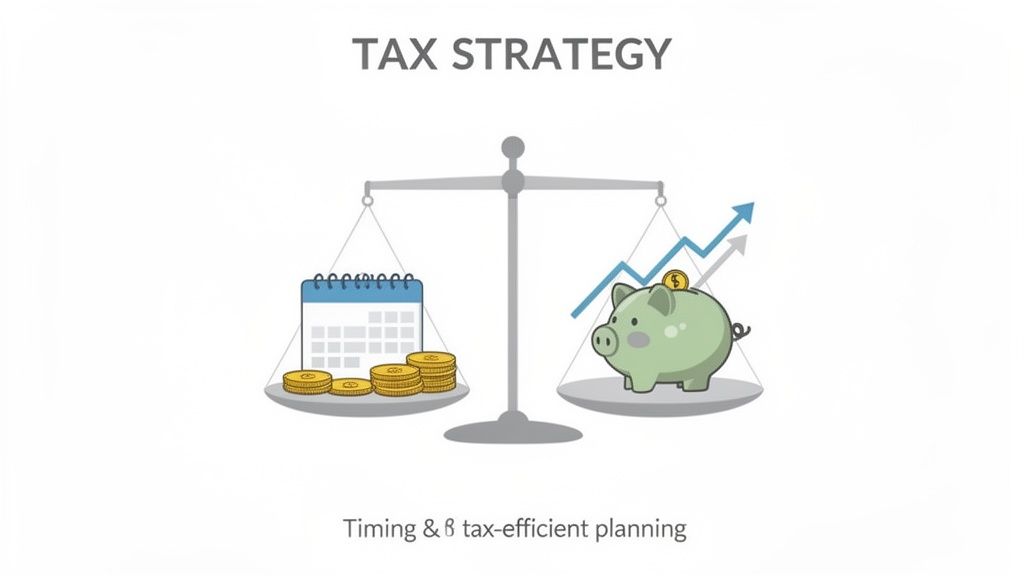
Timing Is Everything: Structuring Investment Decisions
With direct control over your fund’s assets, you can be deliberate about when you buy or sell. This puts you in a position to proactively manage the fund's tax position, especially when it comes to Capital Gains Tax (CGT).
For example, if your fund holds a property or a share portfolio with a significant unrealised capital gain, a trustee might plan to sell that asset after a member has entered the tax-free retirement phase. Because the earnings supporting the pension are tax-free, the capital gain realised from that sale may also be tax-free.
Any decision like this must make sense within your fund’s overall investment strategy. It is a powerful tool that requires foresight. If you are looking to better understand this area, exploring different capital gains tax strategies in Australia can provide valuable context.
Another example is the treatment of franking credits from Australian share dividends. When your SMSF is in the tax-free retirement phase, it can often claim a full cash refund for these credits, creating another source of income for the fund.
The ability to align the timing of investment disposals with the tax status of the fund’s members is a key point of difference for an SMSF. It allows for a level of coordination that is simply not possible in a large, pooled superannuation fund.
The table below gives a simplified snapshot of how this control can play out in practice.
Comparing Potential Tax Treatments: SMSF vs APRA-Regulated Funds
This table provides a simplified comparison of how certain income and events may be taxed within an SMSF versus a large public fund, illustrating potential areas for strategic planning.
| Tax Event | Typical Treatment in APRA-Regulated Fund | Potential Treatment/Strategy in an SMSF |
|---|---|---|
| Sale of Asset with Capital Gain | The fund realises the gain and pays CGT at a fund level, which is then pooled. Members have no control over the timing. | Trustees can strategically time the sale of an asset to occur when members are in the tax-free pension phase, potentially reducing or eliminating CGT on that gain. |
| Franking Credits from Dividends | Credits are used to offset the fund’s overall tax liability. Any excess may be lost in the pooled structure. | When in the pension phase, the fund may be able to claim a full cash refund for all franking credits, boosting overall returns. |
| Asset Allocation for Members | All members are part of a large, single pool. It's not possible to segregate assets for different members. | Assets may be able to be segregated. For example, high-growth assets could be allocated to members in the pension phase to ensure future gains are tax-free. |
While this is a high-level overview, it highlights the granular control an SMSF may offer. The ability to make these deliberate choices, year after year, could compound into a significant difference in your final retirement outcome.
Advanced Structures and Family Scenarios
The strategic possibilities may go even further, especially in funds with multiple members, such as a family.
Consider a couple approaching retirement at different times. They may be able to structure their retirement income streams to maximise the assets held in the tax-free pension phase. This might involve carefully allocating specific assets to support each person's pension, creating a highly tax-effective household income for their retirement years. Good stewardship means understanding that while these strategies exist, their suitability depends entirely on your personal situation, risk tolerance, and long-term goals.
Crafting a Legacy with Sophisticated Estate Planning
When it comes to your super, one of the most powerful advantages of an SMSF is the precise control it may give you over your legacy. It can provide a framework for sophisticated estate planning that may be difficult to replicate in a large, public-offer fund. This structure allows you to direct how and when your superannuation death benefits are distributed, giving you greater certainty that your wishes will be honoured.
This is about more than just completing a form; it is about thoughtful, long-term stewardship for the people you care about. An SMSF can provide the tools to help secure your family’s financial future with foresight and care.
The Power of Binding Death Benefit Nominations
At the heart of an SMSF’s estate planning capability is the Binding Death Benefit Nomination (BDBN). While you may find BDBNs in public funds, an SMSF’s trust deed can be structured to make them more powerful and enduring.
In many large funds, a BDBN may need to be renewed every three years to remain valid. A well-drafted SMSF trust deed, however, can permit a non-lapsing BDBN. This simple difference may remove the risk of your nomination unintentionally expiring, providing a lasting directive for the fund’s remaining trustees to follow when you pass away.
This can offer a profound sense of security, ensuring your instructions remain in place indefinitely, unless you choose to revoke or update them yourself.
Tailoring Your Legacy for Specific Family Needs
The real strength of an SMSF in estate planning can shine through when dealing with complex family situations. Life is rarely straightforward, and your financial arrangements should be able to reflect that reality.
Consider these common scenarios:
- Supporting a Dependant: An SMSF can be set up to pay an ongoing pension to a dependant, like a spouse or a minor child. This could provide a steady, reliable income stream to support them over many years, which may be more beneficial than a single lump sum.
- Blended Families: For blended families, an SMSF can provide unmatched clarity. A BDBN can be carefully structured to ensure specific assets or benefit amounts are directed to children from a previous relationship, while also providing for a current partner. This foresight can help prevent potential disputes.
- Business Succession: For business owners, an SMSF can be a critical tool. It may be integrated into a broader plan, helping to ensure that control of key assets—like a commercial property held within the fund—passes smoothly. Understanding the intricacies of succession planning for a family business can highlight how these financial structures can work together.
The ability to create specific, binding, and lasting instructions for the transfer of your superannuation wealth is a cornerstone of responsible financial stewardship. It transforms your super from a simple retirement account into a key part of your enduring family legacy.
The Importance of Meticulous Documentation
Achieving this level of precision is not automatic. It requires careful and meticulous structuring of the fund’s governing rules, particularly the trust deed. The trust deed is the constitution of your SMSF; it must explicitly allow for the strategies you wish to implement, such as non-lapsing BDBNs or the payment of death benefit pensions.
Getting this wrong can have serious consequences, potentially invalidating your nominations and leaving the distribution of your benefits open to dispute. The language has to be precise, compliant with Australian superannuation and tax law, and aligned with your broader estate plan. For this reason, crafting a robust estate plan within an SMSF is not a do-it-yourself task and professional advice may be appropriate.
Understanding the Responsibilities of an SMSF Trustee
While the advantages of a self-managed super fund can be compelling, they are balanced by significant legal duties. Stepping into the role of an SMSF trustee means moving from a passive member to an active director of your own superannuation fund. You become personally accountable to the Australian Taxation Office (ATO) for the fund's compliance.
With control comes responsibility. Understanding these obligations is the foundation of good stewardship and is essential before deciding if this path is appropriate for you. The journey requires diligence, but with disciplined processes and professional support, these responsibilities are manageable.

Core Duties Under Australian Super Law
As a trustee, you are bound by the rules set out in the Superannuation Industry (Supervision) Act 1993, or the SIS Act. These rules are designed to protect retirement savings. Falling short of these standards can result in significant ATO penalties.
Your core duties include:
- Acting honestly in all matters concerning the fund.
- Exercising skill, care, and diligence in managing the fund.
- Acting in the best financial interests of all fund members.
- Keeping fund money and assets separate from your personal or business assets.
These principles guide every action you take as a trustee.
The Sole Purpose Test: A Non-Negotiable Rule
One of the most critical responsibilities is adhering to the sole purpose test. This is a cornerstone of Australian superannuation law. It dictates that your SMSF must be maintained for the sole purpose of providing retirement benefits to its members, or to their dependants if a member passes away.
Any action that provides a pre-retirement financial benefit to a member or a related party is a serious breach. For example, using the fund's money to pay off a personal debt, lending money to a family member’s business, or living in a residential property owned by the fund are all clear violations.
The ATO scrutinises this rule closely. A breach can lead to the fund being declared non-compliant, which has severe tax consequences, and may result in personal penalties for the trustees.
Annual Compliance and Administrative Obligations
Beyond the guiding principles, there are practical, year-on-year tasks that every trustee must oversee. These administrative duties form the operational rhythm of a compliant SMSF.
Key annual obligations include:
- Meticulous Record-Keeping: You must keep accurate records for all transactions, decisions, and meetings, generally for a minimum of five to ten years.
- Asset Valuation: All fund assets must be valued at their current market value each financial year. This requires an evidence-based valuation for assets like property or unlisted investments.
- Annual Independent Audit: Every year, you must appoint an approved SMSF auditor to conduct an independent audit of your fund’s financials and compliance. The auditor reports their findings to you and the ATO.
- Lodging the SMSF Annual Return: This return includes the fund's income tax return, member contribution details, and regulatory information. It must be lodged with the ATO each year.
Engaging a team of qualified professionals—such as those on our SMSF services team—is a common and sensible approach. While you can delegate the tasks, you can never delegate the ultimate responsibility. It always rests with you, the trustee.
Is an SMSF the Right Path for You?
Deciding on a self-managed super fund is a significant step. The advantages are clear—direct investment control, tailored tax opportunities, and precise estate planning—but they must be weighed against the considerable responsibilities you will take on as a trustee.
This path demands more than just a healthy super balance; it requires your time, a genuine interest, and an ongoing commitment to financial literacy.
A Framework for Your Decision
Before proceeding, it is wise to consider a few key questions. They can help clarify whether the commitment of an SMSF is a good fit for your financial goals.
- Do I have the required time and knowledge? You are legally responsible for every investment decision and all compliance matters. Are you prepared to put in the hours needed to manage the fund diligently?
- Is my balance sufficient? While there is no legal minimum, guidance from both the ATO and ASIC suggests a higher balance is often needed to make an SMSF cost-effective. The fixed costs of administration and auditing can erode returns on smaller balances.
- Does my situation require this level of complexity? The advantages of an SMSF are often most apparent in specific situations, like owning business premises or navigating a complex family estate plan.
Navigating these critical questions is often best done with professional guidance. A calm, professional conversation can help you determine if this path is right for you and whether this structure aligns with your long-term goals.
If you would like clarity on how these principles may apply to your own circumstances, you may wish to speak with a qualified adviser. You can contact Everglow on 1300 913 929 or email contact@everglow.au to arrange a discussion.
General Advice Warning: The information provided in this article is general in nature and does not take into account your personal objectives, financial situation, or needs. Before acting on any information, you should consider the appropriateness of the information having regard to your own objectives, financial situation, and needs, and you should seek personal advice from a qualified financial adviser.
