

For Australian not-for-profit (NFP) organisations, financial management is less about generating profit and more about demonstrating purpose. Effective accounting isn't just about balancing the books; it is about telling the story of your mission and demonstrating accountability to donors, members, and the community you serve. This guide offers a steady overview of the principles that underpin sound financial stewardship in the NFP sector.
The Foundations of Not-for-Profit Accounting in Australia

Unlike a typical business focused on shareholder returns, an NFP's financial narrative is one of stewardship. This is the careful, transparent practice of showing how every dollar is managed to advance the organisation's core mission and maintain public trust. This responsibility is the very bedrock of long-term impact and sustainability.
Navigating this unique financial landscape means working within a framework set by key Australian bodies, primarily the Australian Charities and Not-for-profits Commission (ACNC) and the Australian Accounting Standards Board (AASB). These organisations set the rules, helping to ensure financial reporting may be consistent and transparent across the sector.
Understanding Your Organisation's Role
The primary goal of NFP accounting isn't wealth creation but effective resource allocation. Sound financial governance may allow you to answer critical questions with confidence:
- Are we using our funding as our donors and grantors intended?
- Do our financial activities directly align with our stated mission?
- Are we operating efficiently to maximise our community impact?
- Have we established strong controls to safeguard our assets for future work?
Answering these questions often requires a disciplined approach to bookkeeping and reporting. It forms the foundation of your accountability to everyone, from your board of directors to the broader community. The sector's growth underscores this need for rigour. As of 2025, Australia is home to 62,876 charities and not-for-profit organisations, a significant 5.5% increase from 2024. You can explore further data on the sector's growth at IBISWorld.
The Importance of Size and Structure
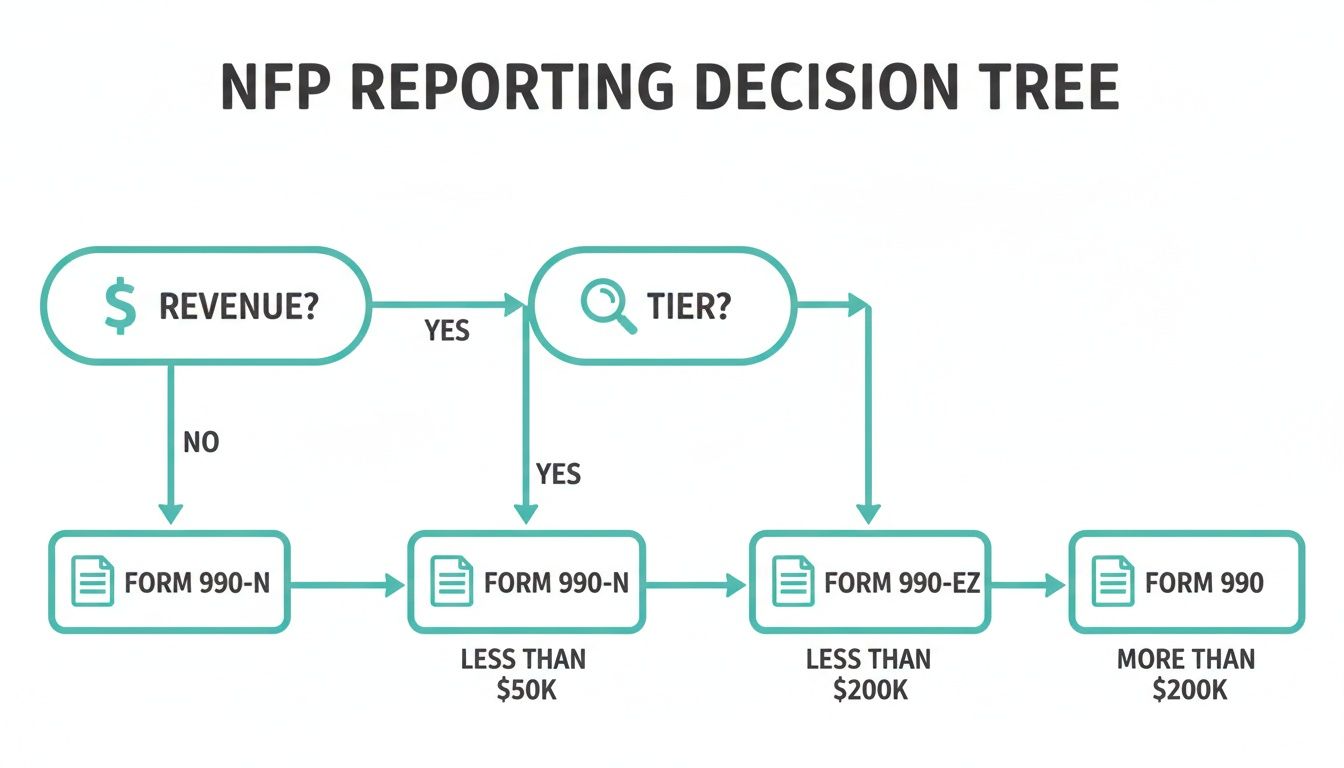
In Australia, an NFP's reporting obligations are tied directly to its size, which is determined by annual revenue. The ACNC categorises charities as small, medium, or large, with each tier carrying different compliance requirements. This tiered system acknowledges that a small community sports club in a regional town may operate with different resources and complexities than a large national health charity.
Good stewardship is about more than compliance; it is the thoughtful and disciplined management of resources entrusted to you. It builds a foundation of trust that is essential for any NFP to thrive over many seasons.
Understanding your organisation's classification is a crucial first step. It dictates the level of financial detail you must report and whether an independent review or a full audit of your accounts may be necessary. This framework helps ensure the compliance burden is proportional to your capacity while still upholding the sector's integrity. For those just starting out, getting these foundations right is vital. You might be interested in our guide on how to start a nonprofit organization for more context on the initial setup process.
Key Regulatory and Reporting Obligations
For any not‑for‑profit, understanding the regulatory world is the bedrock of good stewardship. This isn’t just about ticking boxes; it’s about maintaining the public trust that allows your mission to thrive. In Australia, the Australian Charities and Not-for-profits Commission (ACNC) sets the overarching framework for accountability, while the Australian Accounting Standards Board (AASB) provides the detailed instruction manual on how to prepare financial reports.
ACNC Reporting Tiers
The ACNC recognises that a small community group has different resources than a large national charity. To make compliance manageable, it has created a tiered reporting structure based on annual revenue.
ACNC Reporting Tiers and Financial Obligations
| Charity Size (Tier) | Annual Revenue Threshold | Required Financial Report | Audit or Review Requirement |
|---|---|---|---|
| Small | Under $500,000 | Annual Information Statement (AIS) only. Financial report not required by ACNC. | No audit or review required by ACNC. |
| Medium | $500,000 to $2,999,999 | Annual Information Statement (AIS) and a reviewed financial report. | Financial report must be reviewed by an independent auditor. |
| Large | $3 million or more | Annual Information Statement (AIS) and an audited financial report. | Financial report must be audited by an independent auditor. |
It is a critical task each year to know which tier your organisation sits in, as this directly shapes your end-of-year processes. It is also worth remembering that your own constitution or funding agreements may impose stricter requirements—such as requiring a full audit for a medium-sized charity—regardless of the ACNC’s minimums.
The Role of Australian Accounting Standards and Tax Concessions
While the ACNC sets the framework, the AASB provides the technical rulebook. Key standards like AASB 15 (Revenue from Contracts with Customers) and AASB 1058 (Income of Not-for-Profit Entities) govern how you recognise income from donations, grants, and other sources.
Beyond compliance, the Australian tax system offers opportunities. Eligible NFPs may seek endorsement from the Australian Taxation Office (ATO) for significant tax concessions, which could include income tax exemptions, Goods and Services Tax (GST) concessions, and Fringe Benefits Tax (FBT) rebates.
For example, a community health organisation endorsed as a public benevolent institution could offer its employees salary packaging benefits. This may allow an employee to receive part of their income as a tax-free reimbursement for personal expenses, potentially increasing their take-home pay at no extra cost to the organisation. This is a practical way an NFP can compete for talent. Understanding these rules is a key part of your broader obligations, and a solid grasp helps avoid issues covered by promoter penalty laws and tax compliance.
Risks, Responsibilities, and Practical Stewardship
Sound financial stewardship involves understanding both the opportunities and the responsibilities that come with managing public funds. Key risks often arise from simple oversights rather than a lack of good intention.
Common Responsibilities and Potential Risks
- Fund Management: A core responsibility is separating restricted funds (earmarked for a specific purpose, like a grant for new equipment) from unrestricted funds (for general operations). Failing to track these separately can breach donor trust and create compliance issues.
- Revenue Recognition: Misclassifying revenue—for instance, treating a grant with performance hurdles like an unconditional donation—can lead to inaccurate financial reporting. It is important to apply AASB 15 and AASB 1058 correctly.
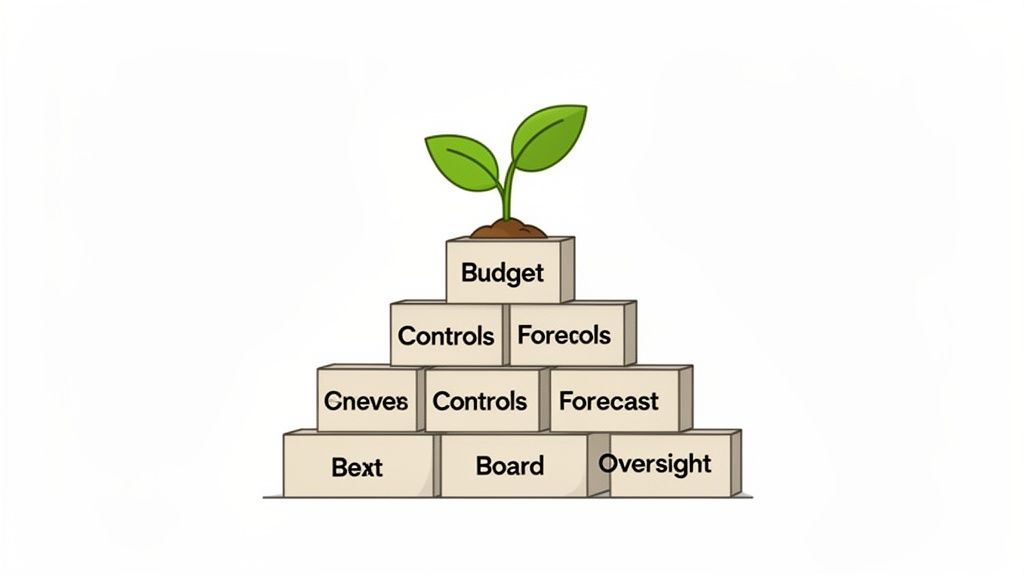
- Internal Controls: Another responsibility is establishing robust internal controls. This could involve simple, practical steps like requiring two signatories for significant payments or ensuring the person approving expenses is not the same person processing the payment. Without these controls, an organisation may be exposed to errors or inefficiency.
- Maintaining Eligibility: The ATO grants tax concessions on the basis that an NFP will continuously operate for its stated purpose. A slip in compliance could put your tax concession status at risk, which may have sudden and significant financial consequences.
Good governance is not about perfection. It is about the quiet, disciplined work of reviewing and improving, day in and day out. It is a commitment to getting the small things right, which builds resilience over time.
For example, a local family-run business making a sizeable donation to a youth centre would expect their contribution to be managed with the utmost care, reinforcing the need for diligent oversight.
Practical Next Steps
Building confidence in your financial processes often comes from taking small, deliberate steps. The following actions can help reinforce the principles of good planning and stewardship.
- Confirm Your ACNC Reporting Tier: Check your organisation's current annual revenue to ensure you are meeting the correct reporting obligations for your size.
- Review Your Tax Concession Status: It may be prudent to periodically check the ATO register to confirm your endorsements for income tax, GST, or FBT concessions remain current.
- Assess Internal Controls: Review who authorises payments, reconciles bank accounts, and handles cash. A simple check can highlight areas for improvement.
- Check Your Chart of Accounts: Does your system easily separate restricted and unrestricted funds? If not, it could be time for a review to ensure it serves your reporting needs.
These are not one-off tasks but part of an ongoing rhythm of good governance. An independent review can provide valuable assurance that your financial framework is robust and fit for purpose. Our Audit and Assurance services are designed to provide this clarity.
Takeaway
Effective accounting for not-for-profit organisations is a practice of stewardship. It requires a disciplined approach grounded in Australian law, a clear understanding of your responsibilities, and a commitment to transparency. By focusing on these foundations, your organisation can build the trust and resilience needed to sustain its mission for many years to come.
If you would like clarity on how these principles may apply to your own circumstances, you may wish to speak with a qualified adviser. You can contact Everglow on 1300 913 929 or email contact@everglow.au to arrange a discussion.
General Advice Warning: The information provided is general in nature and does not take into account your personal objectives, financial situation, or needs. Before acting on any information, you should consider the appropriateness of the information having regard to your own objectives, financial situation, and needs and seek personal advice from a qualified professional.
Want help applying this to your situation?
Every situation is different. Book a time with our team to talk it through, or call us on 1300 913 929.
Book a free meetingOur audit and assurance services →Estimate your fees →
Keep exploring